

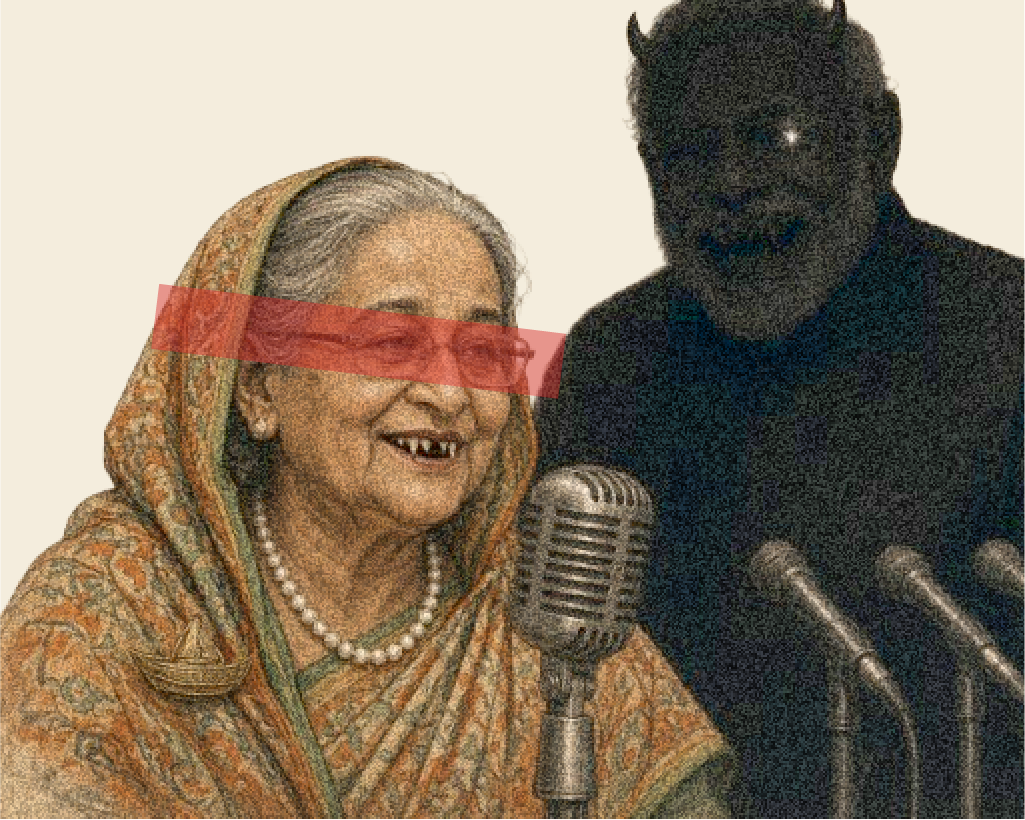
For Bangladesh, the latest interview with Sheikh Hasina is not simply another media appearance.
It is another reminder that the woman who led the country during the crackdown on the July- August 2024 uprising, who fled to India after the fall of her government, and who was later convicted and sentenced to death by Bangladesh’s International Crimes Tribunal for crimes against humanity, continues to live under Indian protection while receiving repeated platforms in the Indian media.
The latest interview, with NDTV, follows a remarkable succession of appearances across major Indian and international outlets. Hasina has spoken to The Hindu, Reuters, Hindustan Times, The Times of India, Anandabazar Patrika, and others in recent weeks and months. Anandabazar Patrika, for instance, published an interview with her earlier this month in which she discussed a possible return to Bangladesh.
For Bangladesh, the question is no longer simply why is Hasina being interviewed?
The deeper question is:
How can Bangladesh and India rebuild trust while India continues to provide a safe haven to a leader convicted by a Bangladeshi tribunal over crimes against humanity and while she is repeatedly given prominent platforms from Indian soil?
The distinction matters.
Hasina is not merely a former prime minister giving interviews from abroad. On November 17, 2025, Bangladesh’s International Crimes Tribunal convicted her in absentia of crimes against humanity committed during the suppression of the 2024 uprising and sentenced her to death. The tribunal's judgment held her responsible under the doctrine of superior command responsibility.
The United Nations has also documented the extraordinary scale of the violence. Its fact-finding investigation estimated that as many as 1,400 people may have been killed during the July-August 2024 crackdown, with thousands more injured. The UN subsequently described the tribunal's verdict as an important moment for victims of the grave violations committed during the suppression of the protests.
For the families of those killed, therefore, seeing Hasina repeatedly appear in India's mainstream media is not an abstract question about press freedom.
It is deeply personal.
It can feel like a denial of what they experienced: that while Bangladesh is still dealing with the deaths, injuries and trauma of the uprising, the person held criminally responsible by a Bangladeshi tribunal is living safely across the border and speaking directly to millions of Indian viewers and readers.
That is where the issue becomes larger than journalism.
A question of dignity
There is an important difference between giving an accused person an opportunity to respond and repeatedly providing a prominent platform to a former ruler who has already been convicted by a court.
Bangladeshis are watching the latter unfold.
The concern is not that Hasina should somehow be silenced. Her statements can be reported, challenged and scrutinised. The concern is the imbalance in visibility: the former leader has an extraordinary ability to communicate her political narrative from India, while the voices of the victims, bereaved families and survivors of the 2024 crackdown often struggle to receive comparable international attention.
This is particularly painful because the narrative surrounding the uprising has itself become contested.
In Bangladesh, the people who died in the streets are remembered by millions as victims of a state crackdown and as participants in a mass movement that ultimately ended Hasina's 15-year rule. The UN's investigation found widespread and systematic violations during the crackdown, including killings of protesters.
Yet Bangladeshis have increasingly watched sections of Indian public discourse frame the post-Hasina political environment primarily through the language of Islamist extremism, minority insecurity and the threat to secularism.
For many in Bangladesh, that framing creates a second injury.
The first was the violence itself.
The second is the fear that the political meaning of those deaths is now being rewritten from outside the country.
The contradiction at the heart of the relationship
Bangladesh is simultaneously being asked to rebuild its relationship with India while the Hasina issue remains unresolved.
Dhaka has sought her extradition. Her continued presence in India has already been described by Indian reporting itself as a major irritant in bilateral relations.
That creates an obvious contradiction.
A relationship cannot be rebuilt solely through diplomatic meetings, trade discussions or official statements if one of the most emotionally charged issues in Bangladesh remains untouched.
For Bangladesh, Hasina is not simply a political personality.
She is inseparable from the violence of July and August 2024, from the deaths of protesters, from the broader record of repression under her government, and now from a judicial verdict concerning crimes against humanity.
Therefore, every time she appears from India with another major Indian media organisation, the question returns:
Does India understand what her continued protection means to the people on the other side of the border?
This is ultimately a question of trust.
Bangladesh and India share geography, history, trade, culture, rivers and millions of human connections. Neither country can erase that relationship. But rebuilding it requires more than strategic calculations. It requires recognition of the wounds that remain open.
For Bangladesh, continued Indian protection of Hasina combined with the steady stream of high-profile interviews she is receiving sends a very different message.
It suggests that the person Bangladesh's justice system has held responsible for crimes against humanity remains politically protected and publicly empowered from Indian soil.
And that is difficult to reconcile with the idea of a genuinely new chapter in bilateral relations.
The question India cannot avoid
The issue, therefore, is not whether India and Bangladesh should have relations.
They must.
The question is what kind of relationship can be rebuilt while the Hasina question remains unresolved?
A sustainable relationship cannot be built by asking Bangladeshis to simply move past the trauma of 2024 while the former ruler at the centre of that trauma continues to receive protection and prominent platforms next door.
The victims cannot be an afterthought.
Their families cannot be an afterthought.
And the judicial process addressing the violence cannot be treated as merely another episode in Bangladesh's political history.
If New Delhi genuinely wants a stable and durable relationship with Dhaka, Bangladeshis will expect more than diplomatic engagement. They will expect their pain, their dead and their demand for accountability to be taken seriously.
Until then, every new Hasina interview from India will carry a meaning far beyond its headlines.
For many Bangladeshis, it will represent the same unresolved question:
How can two countries rebuild trust when one country continues to shelter and provide a powerful public platform to the leader whose government is held responsible for some of the darkest violence in the other's recent history?