

Fantasir Mahmud
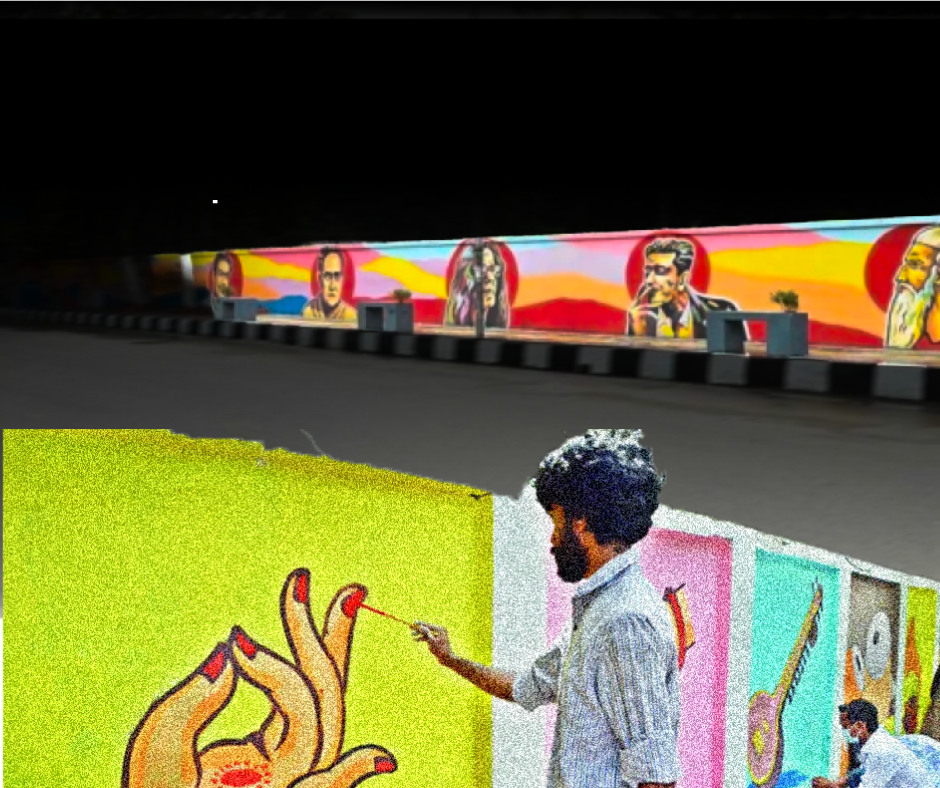
The paintings of several cultural figures on a wall opposite the Bangladesh Shilpakala Academy have drawn considerable appreciation. Undoubtedly, the artwork is beautiful, and at first glance, the initiative appears both positive and commendable. Yet, beneath its artistic appeal lies a subtle form of cultural politics, one that may have escaped the attention of many.
To understand how this politics operates, let us begin with a few questions.
Suppose the Kolkata Municipal Corporation decided to fund murals celebrating the eminent cultural figures of West Bengal across the city. Would those murals feature Humayun Ahmed, Azam Khan, Ayub Bachchu, James, Tareque Masud, or Zahir Raihan?
The answer is unlikely to be yes. Naturally, the Kolkata Municipal Corporation would prioritise the cultural figures of West Bengal. Promoting the contributions of distinguished Bangladeshi artists would not ordinarily form part of its cultural policy.
This raises a fundamental question: why, then, should the walls of Bangladesh feature cultural figures from West Bengal? What aspects of Bangladeshi culture are reflected in the writings, films, or works of Satyajit Ray and Ishwar Chandra Vidyasagar?
This is where the question of cultural politics becomes relevant.
Since July, much of India's longstanding cultural influence over Bangladesh has weakened. Does the current initiative represent an attempt to restore that influence in a new form? It is a question worth asking, rather than dismissing outright.
Why should an institution funded by the taxpayers of Bangladesh provide a platform for promoting Indian cultural figures on the walls of our cities? Citizens have every right to question the priorities of their public institutions and the cultural policies those priorities reflect.
We have heard much about the idea of Dui Bangla, or the two Bengals. Yet, in practice, this notion does not appear to operate in the same way in Kolkata. Bangladeshi cultural figures are not accorded a comparable presence on Kolkata's walls or within its municipal and institutional spaces. Why, then, should the same principle be applied so readily in Dhaka?
The concern is that the idea of Dui Bangla can become a vehicle for turning this side of Bengal into a cultural colony of its more dominant neighbour, rather than fostering a relationship between equals.
Of course, cultural exchange between Bangladesh and West Bengal should continue. We admire Satyajit Ray, watch his films, and recognise his immense contribution to cinema. We respect Ishwar Chandra Vidyasagar. We also appreciate countless gifted artists, writers, and intellectuals from West Bengal. There is no reason to deny their achievements or diminish their contributions.
But cultural exchange is not the same as cultural subordination.
When the cultural figures of another territory receive greater institutional prominence while our own distinguished artists and intellectuals remain inadequately represented, the issue extends beyond artistic appreciation. It begins to convey a political message about whose culture deserves recognition, whose heritage should occupy public space, and whose cultural identity is considered central.
Bangladesh is not a cultural colony of any country. If July has made anything clear, it is that the people of Bangladesh must retain the right to define their own political and cultural identity.
Respecting another culture and surrendering one's own are not the same thing.
We should respect all cultures, learn from one another, and celebrate artistic achievements across borders. But we must do so without sidelining our own people, our own artists, our own history, and our own cultural heritage.
The question is not whether cultural figures from West Bengal deserve to be celebrated. They do. The real question is whether Bangladesh is giving equal thought, space, and recognition to its own cultural legacy.
A nation that fails to represent its own cultural heritage in its public spaces risks allowing others to define its identity for it. Bangladesh must remain open to the world, but it must never lose sight of itself.