

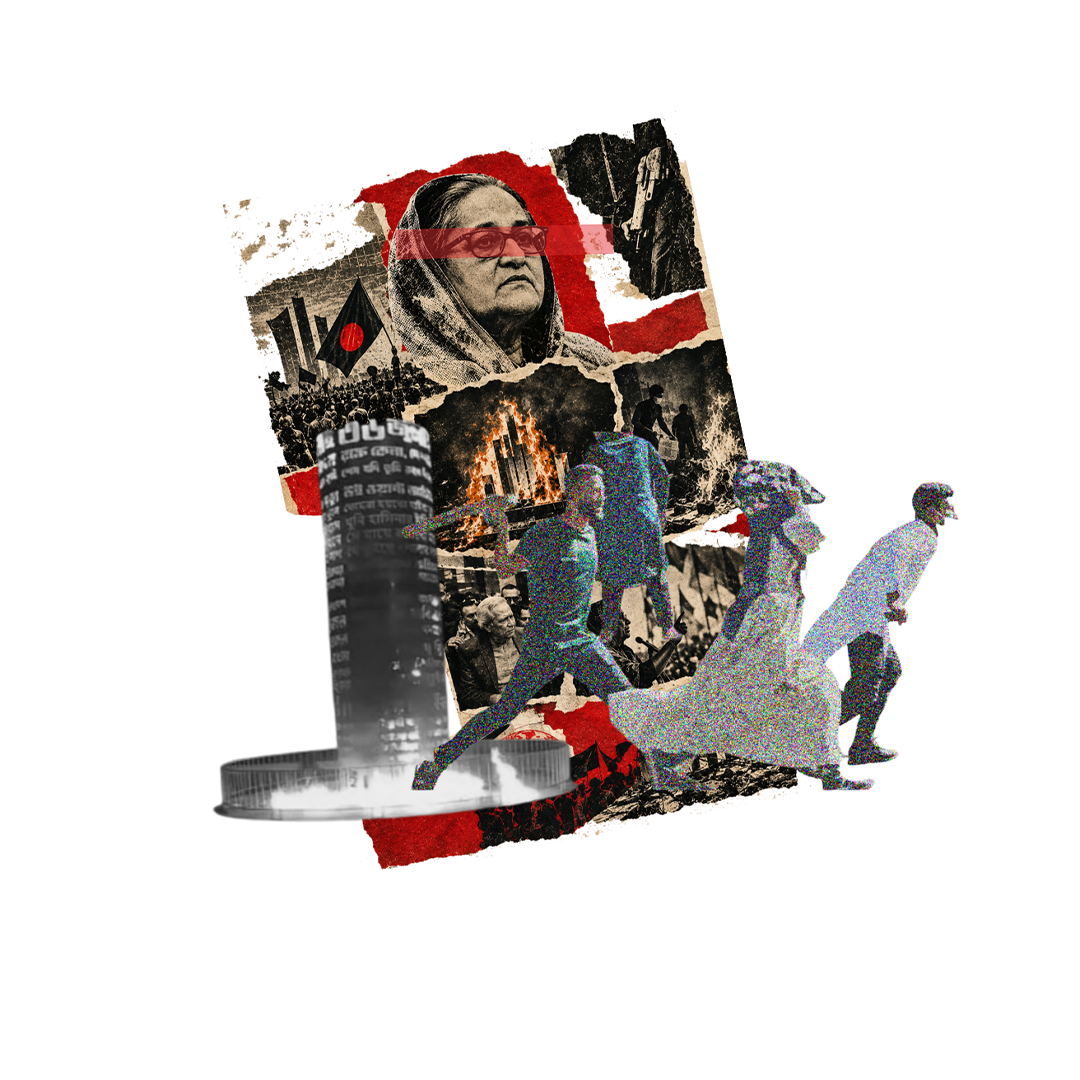
Following the historic collapse of the autocratic regime through the July Revolution of 2024, calls for political stability and social cohesion in Bangladesh led to discussions around establishing a "Truth and Reconciliation Commission." Major political entities, including the BNP and Jamaat-e-Islami, embedded pledges to form such a commission within their national electoral manifestos. Recently, even deposed Prime Minister Sheikh Hasina publicly voiced a desire for "reconciliation." However, according to international political norms and statecraft, true reconciliation necessitates unconditional admission of guilt, truth-telling, and genuine remorse. An analysis of the Awami League's post-July trajectory demonstrates the exact opposite: rather than seeking forgiveness, the party has embarked on a campaign of violent subversion, transnational harassment, historical denialism, and anti-reconciliation tactics.
The most explicit physical manifestation of the Awami League's anti-reconciliation posture is the coordinated wave of arson attacks targeting 'July Martyr Memorials' across 12 districts in Bangladesh. A structural analysis of these incidents reveals a deliberate pattern: attacks were uniformly carried out under the cover of darkness between midnight and 4:00 AM, using accelerants such as petrol, kerosene, and burning tires. The clear objective was to erase the physical symbols of the student-led democratic uprising. Furthermore, operatives belonging to the banned Bangladesh Chhatra League (BCL) routinely recorded 20 to 45-second clips of these acts of destruction, publishing them on social media platforms to celebrate their violence.
Feni: Located barely 150 yards from Feni Model Police Station, the memorial was targeted in the early hours before dawn. Social media footage revealed a masked youth pouring kerosene over the structure and igniting it while accomplices filmed the incident before fleeing.
Manikganj: Situated beside the Manra Bridge along the Dhaka-Aricha Highway in Paschim Seota, the memorial was torched late at night. Three individuals arrived in a black private car, stacked tires around the monument, drenched them in petrol, and fled after igniting the fire, which was later extinguished by locals and police.
Shariatpur: Operatives set fire to a portion of the July memorial under cover of darkness. Following the incident, Mohsin Madbor, convenor of the banned Shariatpur District BCL, shared video footage of the arson on his Facebook page, explicitly claiming credit.
Netrokona: Under late-night cover in the Moktarpada area, perpetrators torched the July memorial. A 25-second video circulating online captured three youths stepping down from the memorial's main altar while chanting political slogans including "Sheikh Hasina will return" and "Joy Bangla."
Noakhali: Situated beside the central Shaheed Minar and Liberation War memorial on District Judges Court Road, this monument was set ablaze at dawn by a group of youths pouring petrol. A 26-second recording captured them shouting political slogans while fleeing; its metallic structure prevented catastrophic structural destruction.
Jamalpur: Perpetrators launched a burning cloth projectile at the July memorial on the premises of Government Ashek Mahmud College. Video of the attack was uploaded by an account named 'Al-Sadek Hridoy,' identified as a former Jagannath University BCL activist residing in Malaysia.
Khagrachhari: Operatives poured petrol and ignited the memorial at Khagrachhari Government College in the dead of night. Although prompt action prevented total destruction, police raided the area and apprehended a former district leader of the banned Chhatra League after a 43-second video surfaced online.
Barguna: Operatives set fire to the memorial on the eastern edge of the Circuit House grounds in the middle of the night, while attempting coordinated road blockades across the district. Rezaul Kabir, president of the banned Barguna BCL, published multiple videos of the arson and disruptions on his personal Facebook profile.
Patuakhali: The memorial adjacent to the southern Circuit House compound was torched at dawn by a masked perpetrator. The president of the banned Patuakhali BCL uploaded the video while making derogatory remarks against the memorial, drawing open endorsement from his followers.
Pirojpur: Perpetrators set fire to the July memorial located on the premises of the central Shaheed Minar under late-night darkness, causing localized surface damage to the monument.
Narayanganj: Despite being under 24/7 continuous police surveillance, the July Martyr Memorial at Hajiganj was torched around 3:00 AM. Additional Superintendent of Police (Crime) Tareq Al Mehdi formally confirmed the sabotage.
Kushtia: Perpetrators torched the July memorial located at the Shaheed Abrar Fahad Stadium compound at approximately 4:00 AM before dawn.
The Awami League's aggressive hostility has not remained confined to domestic borders; rather, party loyalists have exported their campaign of intimidation across international arenas, targeting cultural figures and state dignitaries who supported or led the July transition:
Assault on Actress Azmeri Haque Badhon in Venice (September 8, 2026): Renowned actress Azmeri Haque Badhon was assaulted and harassed in Venice by Awami League supporters purely due to her active participation in the July mass movement. The harassers repeatedly branded her a "terrorist" and aggressively attempted to force her to chant the partisan slogan "Joy Bangla."
Harassment of Dr. Muhammad Yunus at JFK Airport (October 13, 2026): Nobel laureate and former Chief Adviser Dr. Muhammad Yunus was ambushed and bullied by Awami League activists at John F. Kennedy (JFK) International Airport in New York. The incident demonstrated the organization's ongoing pursuit of public confrontation and vindictive hostility on foreign soil.
Beyond physical sabotage and international harassment, leaked audio communications from top leadership reveal a direct strategy of violent retaliation. In a leaked telephone conversation ordering targeted political violence, Sheikh Hasina explicitly instructed a party leader:
"You must launch attacks on BNP and Jamaat. Do whatever it takes; start right now."
This instruction proves that violence remains an official party instrument. Even more alarming was a leaked Zoom meeting where a party activist declared, "Leader, we too will assassinate them in the future, Insha'Allah." Instead of rejecting extrajudicial murder, Sheikh Hasina explicitly encouraged the activist, replying:
"Talk less. Those who talk too much can achieve nothing. Less talk, more work. Show it by doing it first."
This exchange confirms a high-level endorsement of political assassinations. Furthermore, expressing intense personal vengeance against the interim leadership, Hasina was recorded saying, "May Allah grant me the day when I can put handcuffs on Yunus, tie a rope around his waist, and put him behind bars."
The July Uprising represented the collective democratic movement of tens of millions of citizens, prompting the interim administration to enact legal indemnities to protect civilian participants from political persecution. The Awami League, however, continues to label the entire populace that stood against its rule as "terrorists." In another recording, Hasina threatened mass prosecution:
"The indemnity given to protect these criminals will be revoked, and every single criminal will be prosecuted."
By declaring the entire citizenry as "criminals" subject to future retribution, carrying out targeted assaults both at home and abroad, and actively pursuing vengeance, the Awami League has declared war on the public itself. Without an iota of remorse or accountability, rhetoric regarding a "Truth and Reconciliation Commission" is merely a hollow distraction. Through systematic arson, violent directives, and hostility toward the democratic transition, the Awami League has completely destroyed the possibility of political reconciliation.