


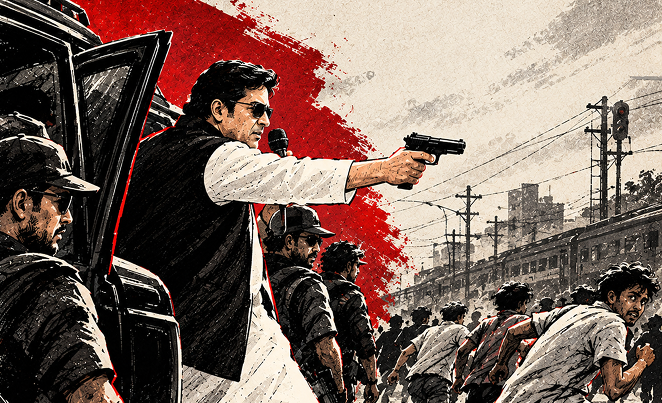
A State Minister steps out of his car, a hand mic in one hand and a pistol in the other, and chases a group of drug users. They scatter in panic. The ones who get caught are taken to the police station. No, this is not a scene from a Bombay film. It happened on Saturday afternoon, 17 October, beside the railway line in Gendaria, Dhaka. State Minister for Liberation War Affairs Ishrak Hossain staged it, filmed it and posted the footage on his own Facebook page.
Can an elected public representative chase people with a raised weapon? Is the weapon legal? And what of the weapons in the hands of the men around him? Even if his own pistol is licensed, can it be used to frighten people instead of to defend oneself? Set the legal framework aside and ask it morally: can a State Minister do this? Law enforcement personnel are supposed to be with him, and this is their job. Hasn’t it become a bit too much of a show of heroism?
The reports agree on the basics. The officer in charge of Gendaria police station said the minister himself detained six people and phoned the station, after which police went and took them into custody. Police say he did not tell them about the operation beforehand. The video shows two of the detained men being beaten, and another report says a man introduced as the minister’s official bodyguard kicked a young man while someone else, unidentified, threatened to shoot. The minister’s own account is that gunfire had occurred in the area, so he kept the weapon for his own security, and armed police were present. He says he did not shoot or frighten anyone. His assistant private secretary went further and said he carried a stick, not a pistol. The video, which we have watched, shows a pistol.
It shows something else too, and this is the part that should worry us most. The minister was not alone, and the people around him were not the state. Pavel Sikdar, former convener of the Dhaka Metropolitan South Chhatra Dal, was with him on the spot. Men in clothing made to look like Detective Branch uniform move around him as if they were law enforcement. Look closely and the vests carry the ruling party’s logo. Among them, Pavel Sikdar, who holds no post in any law enforcement agency, walks around with what looks like an M16-type automatic rifle. To my knowledge, Bangladesh does not license civilians to carry military-grade automatic weapons, and I know of no provision that lets the state hand one to a party worker for a raid like this. A State Minister, in other words, is running his own militia, armed with illegal weapons, in his own constituency.
Start with the law on the minister’s own pistol. Whether it was licensed cannot be known from the video. Under the Arms Act 1878 and the Arms Rules 1924, you need a license to keep a firearm, and a license does not allow you to raise it to scare someone. As far as I know, being a State Minister gives no special power here. What matters is whose name the license is in and for what purpose. The rifle raises a harder question. If it is not licensed, and a civilian license for such a weapon does not exist, then every person who handled it and every person who armed him has a case to answer.
Self-defense does not fit the facts either. Sections 96 to 106 of the Penal Code recognize a right of private defense, but it exists to ward off imminent danger, and section 99 bars causing more harm than necessary. A man running away is no imminent danger to anyone, so aiming a weapon at him is not self-defense. Sections 503 and 506 on criminal intimidation come into play, and holding people after catching them raises wrongful confinement under section 342. If anyone wore clothing meant to pass as a police uniform, the Penal Code’s provisions on personating a public servant come into the discussion as well. A court would have to prove all of it.
Then there is the power to catch people and deliver them to the police. Section 59 of the Code of Criminal Procedure lets an ordinary citizen arrest someone who commits a cognizable, non-bailable offense in his presence, but he must hand that person to the police without unnecessary delay. The minister stands exactly where any citizen stands. Under the Narcotics Control Act 2018, raids, searches and arrests belong to officers the law designates, such as the police and the Department of Narcotics Control. A party worker in a logo vest has no such authority.
Articles 31 and 32 of the Constitution forbid harming anyone’s life, liberty, body or reputation except in accordance with law. Article 35(5) prohibits torture and cruel, inhuman or degrading treatment. Beating detained men, kicking a young man, and filming and spreading the video invite the question of whether this falls under that last article. A minister’s oath also pledges fair treatment of everyone in accordance with law.
His position settles the rest. Law and order is the Home Ministry’s field, and the Ministry of Liberation War Affairs has no role in it. A Member of Parliament makes laws and holds the executive to account. Visiting his own constituency does not hand him police work. The UN Basic Principles on the Use of Force and Firearms (1990) say that even police may use firearms only as a last resort, after a warning. If the rule is that tight for police, it should be tighter for someone who is not police.
Why do politicians do this? In 1964, the political scientist Murray Edelman showed that politics runs largely on symbols. Real work takes time to show results, and a dramatic scene delivers its message at once. John Pratt and David Garland made a similar point about crime-control politics: when the public is angry, leaders put on a show of toughness, because the posture is easy to show and results are hard to show. Duterte’s anti-drug campaign in the Philippines is the obvious example, and the tough-leader image draws votes. Social media pushes in the same direction. A 2017 study by Brady and colleagues found that moral-emotional language spreads much faster online, so a video along the lines of “I took on drugs myself” earns more shares than the results of any real work.
Drug users are also the easiest targets. Stanley Cohen’s “moral panic” describes them well: society despises them and few will stand up for them. Going after the big networks in the drug trade might mean a clash with people close to power. So the people who end up on camera are the most vulnerable ones.
The cost is real. The first damage is to the message about the rule of law. Tom Tyler’s research found that people obey the law mainly because they see fair process and legitimacy, and less because they fear punishment. When a minister skips process himself, what do people learn? The police land in an awkward spot too. What does a station do with people brought in by an armed party group with no official authority, and how long would such an arrest survive in court?
People addicted to drugs are also patients who need healthcare. In June the Home Minister said that 8.2 million people in the country are addicted, 4.88 percent of the total population. Fear and public humiliation do not cure people in those numbers. They push them further away from treatment. By human rights organizations’ counts, several hundred people were killed in the 2018 anti-drug campaign, and we have seen no strong evidence that drug use or supply fell afterward.
Then there is the example it sets. If a public representative goes out with a pistol to deliver “justice” himself, party workers and local strongmen will feel free to do the same. This country has a history of mob beatings and trial by crowd, so the fear is real. A weapon in a crowd also carries the plain risk that one small mistake becomes a gunshot.
And we have seen what armed party men beside the state can lead to. In July 2024 we watched leaders and activists of the then ruling Awami League fire automatic weapons at protesters and kill them. The UN human rights office’s fact-finding report later documented the role of party-affiliated armed men alongside the security forces. Gendaria is not July, and a drug-den raid cannot be set beside a massacre. But the structure is the same: party loyalists with weapons, working beside the state with no legal authority and no accountability. Once that is normal, the next target can be anyone, and not only drug users.
Gendaria is also not Ishrak Hossain’s first controversial moment. On the day he took his oath as an MP, he failed to arrive on time and so took the oath in the second round with the Jamaat-led alliance and the independents, not with his own party’s members. In parliament he issued warnings about the opposition’s downfall.
Yet in the fascist era we saw Ishrak Hossain as a great promise of youth. He entered politics as the son of former mayor Sadeque Hossain Khoka, but within a short time he drew everyone’s attention through a few brave acts. He shouted a declaration of resistance from a prison van. When the police unlawfully detained one of his workers and took him away, he ignored his own safety and brought him back. After the fascist government fell, something went wrong. One strange act after another has made him a figure of ridicule in many people’s eyes.
Back then his courage meant taking a risk himself to protect someone else. Now the risk is aimed at others in front of a camera, and those others are the most defenseless people in society. What we ask of this young leader today is modest. We want a public explanation of the Gendaria incident, and an impartial check on his pistol’s license and its use. We want the armed group around him dissolved, its weapons seized and traced, and whoever armed and dressed it held to account. And we want the public anger over drugs channeled through the police station, the Department of Narcotics Control, the courts and the rehabilitation centers, all of which work within the law he swore to uphold as a minister.