

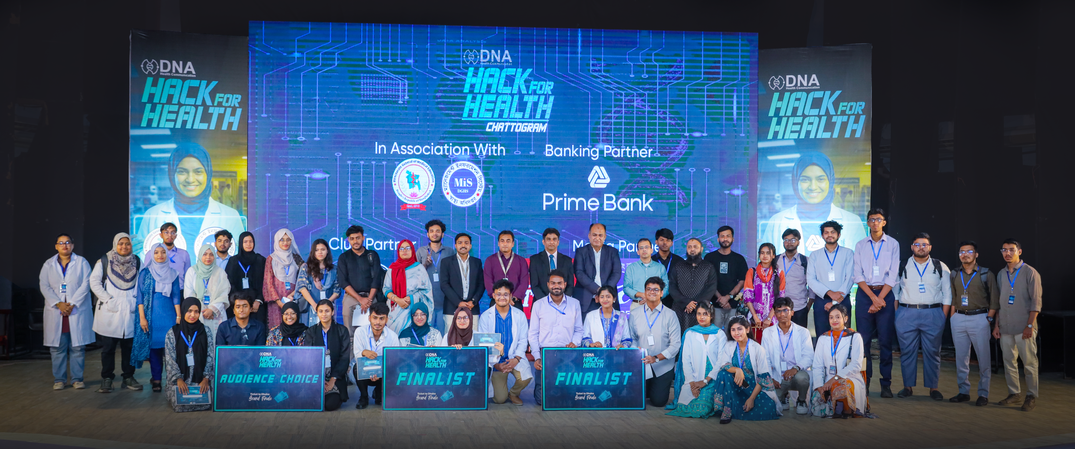
In a landmark convergence of medicine, artificial intelligence, and public health, Hemo Hackers has been crowned Champion at DNA Hack For Health 2026 - Chattogram, held today at Chittagong Medical College. Their solution uses deep learning and smartphone-based imaging to predict hemoglobin levels non-invasively from fingertip videos - making anemia monitoring painless, affordable and accessible for pregnant mothers, thalassemia patients and rural communities. Claiming the Runner-Up position is Rhetoric Minds, whose 'Prottoy Mesh' - an offline-first, QR-based patient identity system - ensures life-saving medical data remains available at the point of care even during power outages and natural disasters. Arekta Team secured the Second Runner-Up position with an AI-powered gait analysis platform enabling remote neurological rehabilitation for stroke and Parkinson's patients. All three teams now advance to the National Grand Finale in Dhaka.
Professor Dr. Mohammed Jashim Uddin, Principal of Chittagong Medical College and Chief Guest of the event, remarked that producing truly transformative healthcare professionals requires nurturing minds that are as comfortable with technology as they are with clinical practice and that today's event demonstrated exactly that potential. Professor Dr. Md. Abdur Rab, Vice Principal of Chittagong Medical College, graced the occasion as the Guest of Honour.
The day's plenary session brought together a distinguished panel of clinicians, engineers and health-tech leaders. Dr. Sumit Mazumder, Assistant Professor of Biomedical Engineering at CUET, set the tone: "We should not be technology-driven; rather, we should be technology-assisted." He further emphasized that regulatory and policy barriers continue to discourage private investment in health R&D in Bangladesh. Dr. Abdullah Abu Sayeed, Assistant Professor of Medicine at CMC, affirmed that while AI is increasingly reshaping diagnostic tools, including MRI and CT technologies, clinicians will remain central to biomedical decision-making.
Professor Dr. Mohammad Masud Karim, Professor and Head of Surgery at Chittagong Medical, called for a regulatory authority for AI in healthcare modeled on the BMDC, noting that Bangladesh currently lacks both the data infrastructure and the governance framework needed to ensure safe deployment of robotic and AI-driven medical interventions. Dr. Rivu Raj Chakraborty, Associate Professor and Head of the Casualty Department at CMC, echoed the need for a proper authoritative body to regulate and introduce robotic surgeries.
Concluding the panel, all speakers reached a unanimous agreement: Bangladesh urgently needs an independent third-party monitoring framework for healthcare technology and AI; future physicians must be engineering-minded and technologically literate; and subjects such as data science should be formally integrated into the MBBS curriculum.
"The mandate from the experts in Chattogram was clear: our medical curriculum must evolve to include data science, and we urgently need robust regulatory frameworks for AI in healthcare. DNA Hack For Health is designed to expose these exact improvement areas. We are not just hosting a hackathon; we are forcing a necessary national dialogue. The brilliant solutions from Hemo Hackers and others show what is possible when we merge medicine with engineering - now, the system must adapt to support them."
- SMO Nawed, founder of DNA Health Communication
Dr. Md. Abdus Sattar, Professor and Head of the Department of Medicine at CMC, delivered one of the session's most pointed remarks: "If we fail to adopt these technological advancements into our curriculum, we will fall behind the rest of the world. Diagnosis and clinical expertise can never be fully replaced by AI; context and systems matter far more than simply adopting new tools. We are genuinely impressed by the students stepping forward with innovative ideas. But doctors must also learn to understand engineering."
Muhammad Asif Atick, Senior Consultant at DGHS/MIS and National ICT Award Winner, stressed that tackling Bangladesh's healthcare challenges demands a global perspective: "We need broader exposure to identify nationwide problems by looking beyond our own borders and drawing inspiration from countries like the United States and India. Only then can we solve local problems with global thinking." He also called on students to first understand the existing healthcare system, available resources and national capacity before launching new initiatives.
Prime Bank, returning as Banking Partner for the Chattogram edition, expressed that they feel privileged to be part of this movement once again and reaffirmed their commitment to remain partners in this journey for the long term.
Chattogram has made one thing unmistakably clear. The transformation of Bangladesh's healthcare sector is not waiting for policy alone; it is already being built by the next generation. DNA Health Communication has confirmed that the hackathon will reach every divisional medical college this year. And the vision goes beyond innovation: Walkathons, Marathons, Art and Photography Exhibitions and Standup Comedy shows for healthcare professionals are woven into a year-round programme designed to nurture both the minds and the well-being of those building this future. In this blend of technology and humanity, a new chapter for Bangladesh's health sector has already begun.