

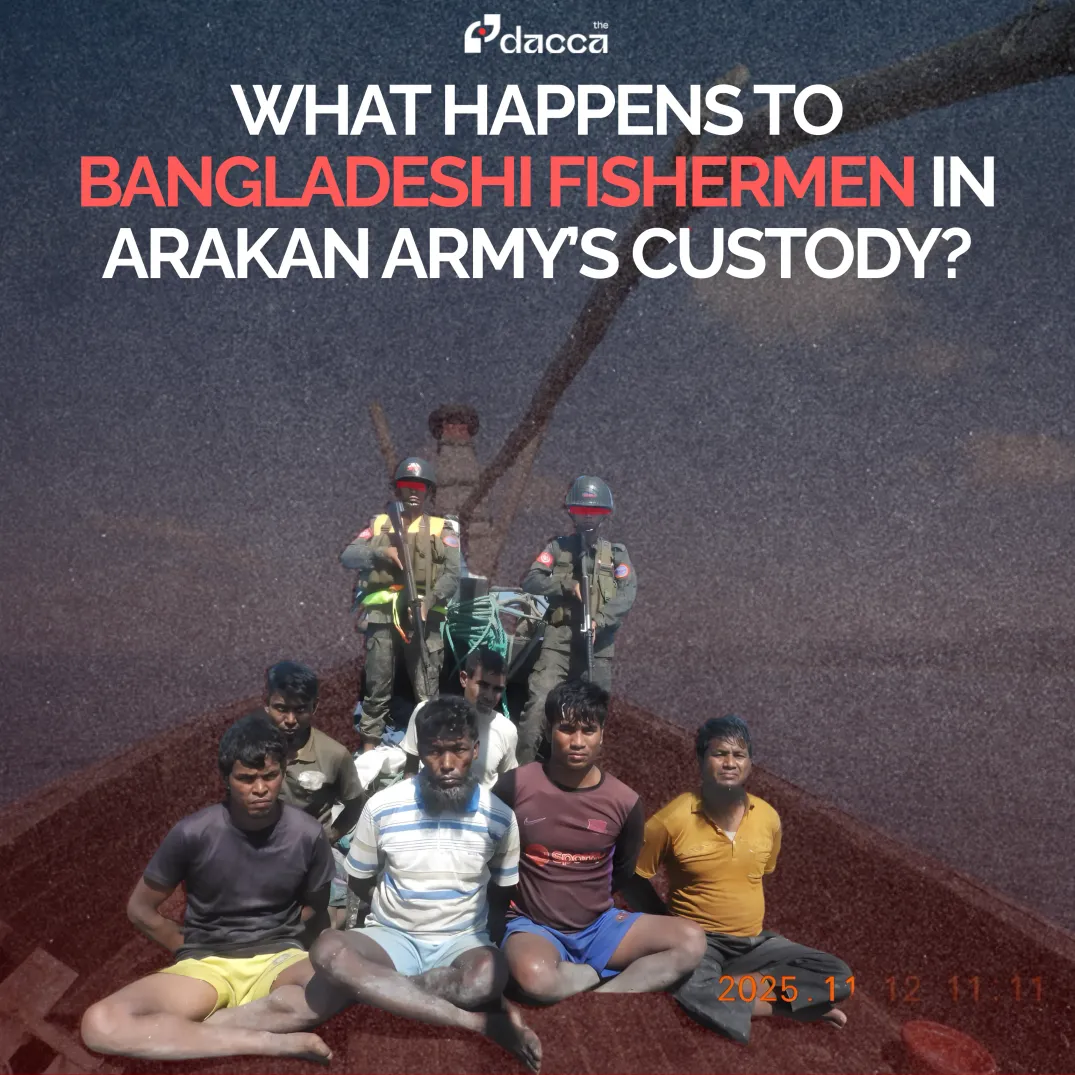
Every year, Bangladeshi fishermen cross the Naf River hoping to return with a day’s catch. For many, that journey ends in detention. Over the past year alone, hundreds have been seized by Myanmar’s Arakan Army (AA), turning a livelihood into a legal and humanitarian crisis.
According to media sources, around 250 fishermen were arrested by the Arakan Army in 2025 alone. Border Guard Bangladesh (BGB) reports a higher number: 325 arrests between December 2024 and September 2025. However, The Dacca's investigation, based on victim testimonies and cross-referenced official data, reveals the actual figure is far grimmer: more than 400 Bangladeshi fishermen have been detained by the Arakan Army during this period.
• 6 March — 56 arrests (Source)
• 11 March — 3 arrests (Source)
• 25 August — 26 arrests (Source)
• 28 August — 30 arrests (Source)
• 11 September — 40 arrests (Source)
• 30 September — 14 arrests (Source)
• 12 November — 8 arrests (Source)
• 18 November — 16 arrests (Source)
• 27 november — 12 arrests (Source)
• 3 December — 6 arrests (Source)
• 18 December — 9 arrests (Source)
• 22 December — 6 arrests (Source)
• 23 December — 13 arrests (Source)
There is, however, a clear mismatch between the numbers cited by the BGB and those acknowledged by the Arakan Army. According to our investigation, many detainees are released after paying bribes before being taken into AA camps. Since they never formally enter detention facilities, the Arakan Army does not count them as detainees, keeping their official figures significantly lower.
The Arakan Army justifies the arrests by citing security threats. AA argues that ARSA and RSO militants frequently disguise themselves as fishermen in the Naf River to launch surprise attacks on AA members and civilians. The group also claims these militants act as proxy forces for BGB and use fishing boats to smuggle essential goods into Arakan, prompting AA to detain anyone they deem suspicious.
Given the discrepancies in official accounts and the gravity of the situation, The Dacca decided to investigate this matter thoroughly. We spoke with a close affiliate of the Arakan Army and contacted a family member of a victim currently serving jail time in an Arakan Army prison. Both sources requested anonymity due to security concerns. Their testimonies reveal a disturbing pattern of extortion and abuse.
The process begins immediately upon detention. Fishermen are first taken to an AA checkpost, where they are allowed to contact their families in Bangladesh. At this stage, the Arakan Army demands a ransom, typically between Tk 50,000 to 1 lakh, for their immediate release. Those whose families can pay are freed on the spot and never officially recorded as detainees. Those who cannot are transferred to AA camps.
In the Army camps, conditions are harsh. Detainees are brought before Arakan Army-run courts, where they are told to hire lawyers. However, these lawyers are not certified advocates, but rather local Rakhine-speaking representatives whose only task is to negotiate the bribe amount for release. Detainees are brought to court at least three times, and with each appearance, the demanded bribe increases. The bribe typically ranges from 1 lakh to 5 lakh BDT. If they still cannot pay after the third hearing, they are sentenced to 4 to 5 years in prison.
Given the financial condition of most fishermen, paying these escalating bribes is impossible. Inside detention, the exploitation continues—fishermen are forced to pay Tk 2,000 to 5,000 per week for food. Those who cannot pay are left to starve. To date, not a single person sentenced to jail by the Arakan Army has returned to Bangladesh.
Despite the growing crisis, government response remains limited. In November 2024, Khalilur Rahman was appointed the interim government's representative on the Rohingya Crisis, and later also made National Security Advisor. Security analysts say the dual mandate has paralyzed action. According to the Bangladesh High Commission, they maintain regular contact with victim families and engage in diplomatic talks with the Arakan Army. But so far, the situation remains unchanged—a pattern that has persisted for years. The Arakan Army operates with impunity, the BGB negotiates in vain, and families wait—desperate, helpless, and abandoned by the very government meant to protect them.