

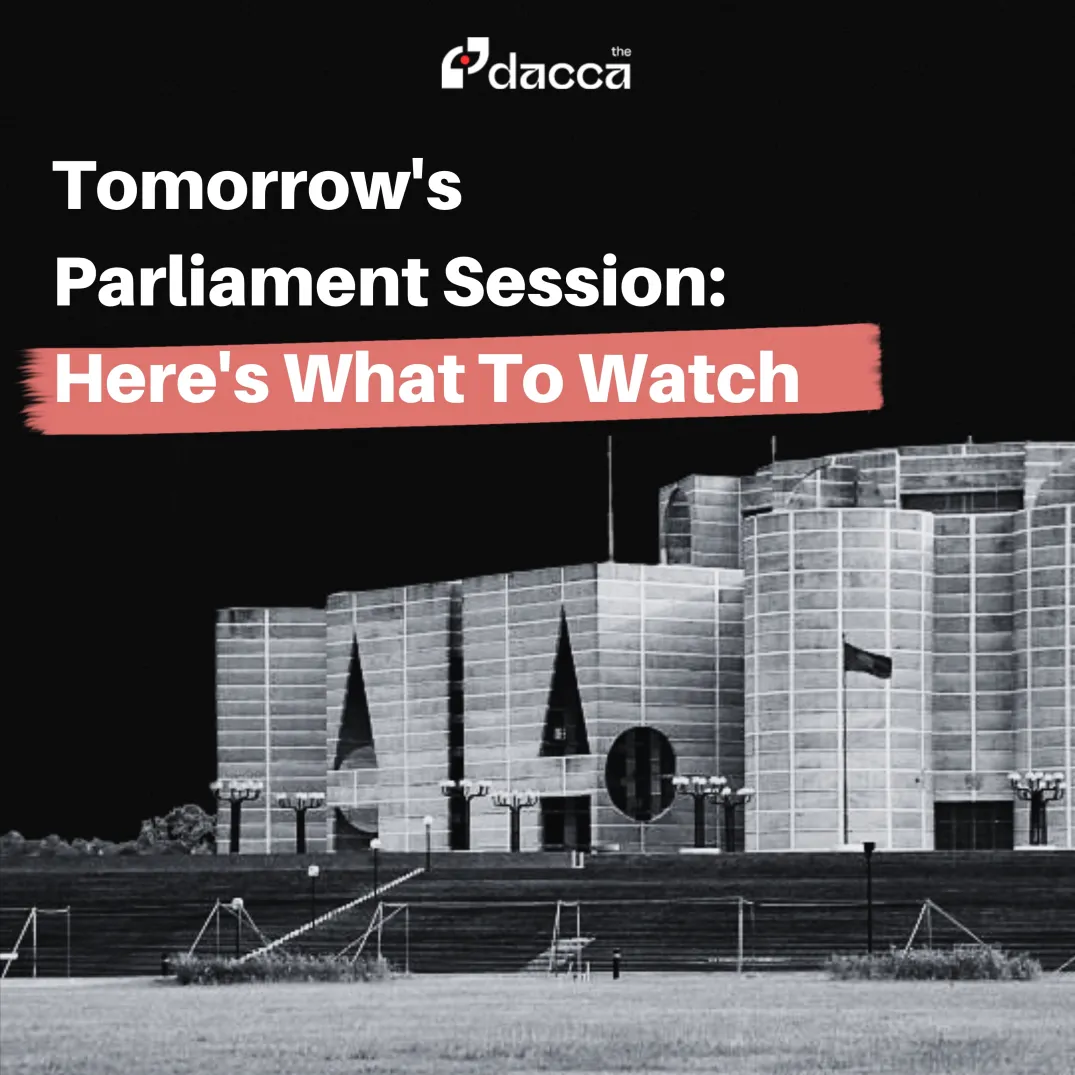
Bangladesh's new parliament convenes on Thursday morning for the first time since the mass uprising of July 2024 toppled Sheikh Hasina's government and ended nearly two decades of Awami League rule. The 13th Jatiya Sangsad is, on paper, a routine inaugural sitting — electing a Speaker, swearing in leadership, setting the calendar. But nothing about this parliament is routine. And almost nothing about today will be.
The Bangladesh Nationalist Party enters the chamber holding a commanding majority — a mandate won in the February 12 general election. Yet even with that strength, the BNP begins its legislative life with a contradiction at its core: a public commitment to constitutional reform it has allegedly begun walking back, an opposition that questions the very legitimacy of the head of state opening proceedings, a stack of 133 laws inherited from the interim government, and an alliance partner whose cooperation hinges on whether the ruling party keeps its word.
Four storylines will define what kind of parliament this turns out to be. Not all four will be resolved today. But the signals sent on Thursday will echo for months.
The July Charter Question
The July Charter is the founding document of Bangladesh's post-uprising political settlement. Signed by 24 political parties and the interim government's National Consensus Commission, it proposes over 80 constitutional and governance reforms — term limits on prime ministers, a bicameral legislature, an independent election commission, enhanced presidential accountability, and greater women's representation, among others.
BNP MPs took the parliamentary oath. They did not take the second oath — the one that would have constituted them as members of the Constitution Reform Council, the body the charter itself created to encode these reforms into law within 180 working days. The party argues that reforms should instead be pursued through ordinary parliamentary process, and that the Council has no basis in the existing constitutional framework.
The opposition bloc — Jamaat and the NCP — took both oaths. Two separate institutional frameworks now exist within a single parliament.
Complicating matters further, a group of lawyers publicly identified as BNP-aligned has filed a petition in the High Court challenging the legality of the July Charter itself. A faction within the ruling party's own orbit is arguing in court that the document BNP leaders have publicly pledged to implement is unconstitutional. The contradiction is not yet a crisis. But it is a contradiction, and it is visible from day one.
The core question Thursday raises is not whether the charter dies today — it won't. It's whether BNP's opening moves signal a genuine reformist posture, or a government that has decided to use the charter's language while quietly engineering its irrelevance.
President Chuppu's Address: A Ceremony Shadowed by Legitimacy
Under constitutional convention, President Shahabuddin Chuppu convened Thursday's session and is scheduled to address the House — a traditional feature of inaugural sittings that formalises the government's legislative agenda. The BNP has confirmed he will speak.
The opposition has made equally clear it does not accept his right to do so.
Jamaat Deputy Opposition Leader Syed Abdullah Mohammad Taher called the president "an ally of the fascists" and told reporters the party had already made decisions about how to respond to his address — decisions it would reveal on Thursday. NCP chief and opposition leader Nahid Islam has gone further, urging BNP to use the first session to initiate impeachment proceedings against Shahabuddin, arguing his continued presence represents the old order's institutional grip on the new republic.
The BNP's position is clear: they want continuity, not confrontation. Removing Shahabuddin would require a two-thirds majority vote and a political fight the ruling party has not chosen to pick.
What happens when he speaks — whether opposition benches empty, whether there is a silent protest, whether proceedings unfold with or without disruption — will set the temperature of this chamber from day one. A walkout is largely symbolic. But symbols have weight in a parliament that is still deciding what it stands for.
The Deputy Speaker Offer: An Olive Branch With Conditions
One of the July Charter's most concrete proposals was that the Deputy Speaker be elected from the opposition — a significant departure from the convention of the ruling party holding both presiding positions simultaneously. BNP has offered the seat to Jamaat, framing it publicly as a goodwill gesture and an early act of charter implementation.
Jamaat's response has been precise: the party may not accept the offer unless BNP first takes the oath of the Constitution Reform Council. Taher told reporters on Wednesday that the party had "made its decision" and would announce it on Thursday. The deliberately suspended answer is itself a message — Jamaat is maximising its leverage before the session begins.
This is the charter's first concrete test. If Jamaat refuses the offer, BNP's claim of charter implementation loses credibility immediately. If Jamaat accepts without conditions, it hands BNP an easy symbolic win while abandoning its core demand.
The 133 Ordinances: Eighteen Months of Executive Power, Now Before Parliament
Between August 2024 and February 2026, Bangladesh was governed without a legislature. The interim administration relied heavily on Article 93(1) of the constitution — which allows the president to promulgate ordinances when parliament is not in session — and used that authority 133 times over 18 months. The ordinances cover substantial ground: financial regulation, judicial reform, criminal procedure, anti-corruption institutions, human rights bodies, and more.
The constitution is unambiguous: all 133 must be placed before parliament in the first session, after which a 30-working-day clock begins. Any ordinance not approved within that period lapses automatically. All 133 will be tabled Thursday.
The practical stakes are enormous. Some of these ordinances, if they lapse, would create legal vacuums in active policy areas. Others, if they are made permanent, will lock in institutional changes that opposition parties and civil society groups have already criticised as insufficiently consultative. The question of which ordinances BNP keeps, which it amends, and which it quietly lets expire will be one of the most consequential legislative exercises this parliament undertakes — and it begins today.
What Thursday Actually Decides
No single session settles a country's political direction. Thursday's sitting will likely end without resolution on most of what matters: the Reform Council standoff will continue, the president's legitimacy will remain contested, the Deputy Speaker question may be deferred, and the ordinance review will unfold over weeks.
What Thursday does settle is tone. A parliament that begins with a presidential walkout, a collapsed alliance offer, and a ruling party visibly uncomfortable with the commitments it campaigned on is a parliament that will govern through attrition rather than consensus. A parliament that manages its contradictions — even partially, even imperfectly — signals that the July uprising's political gains are being absorbed into institutions rather than dissipated by them.