

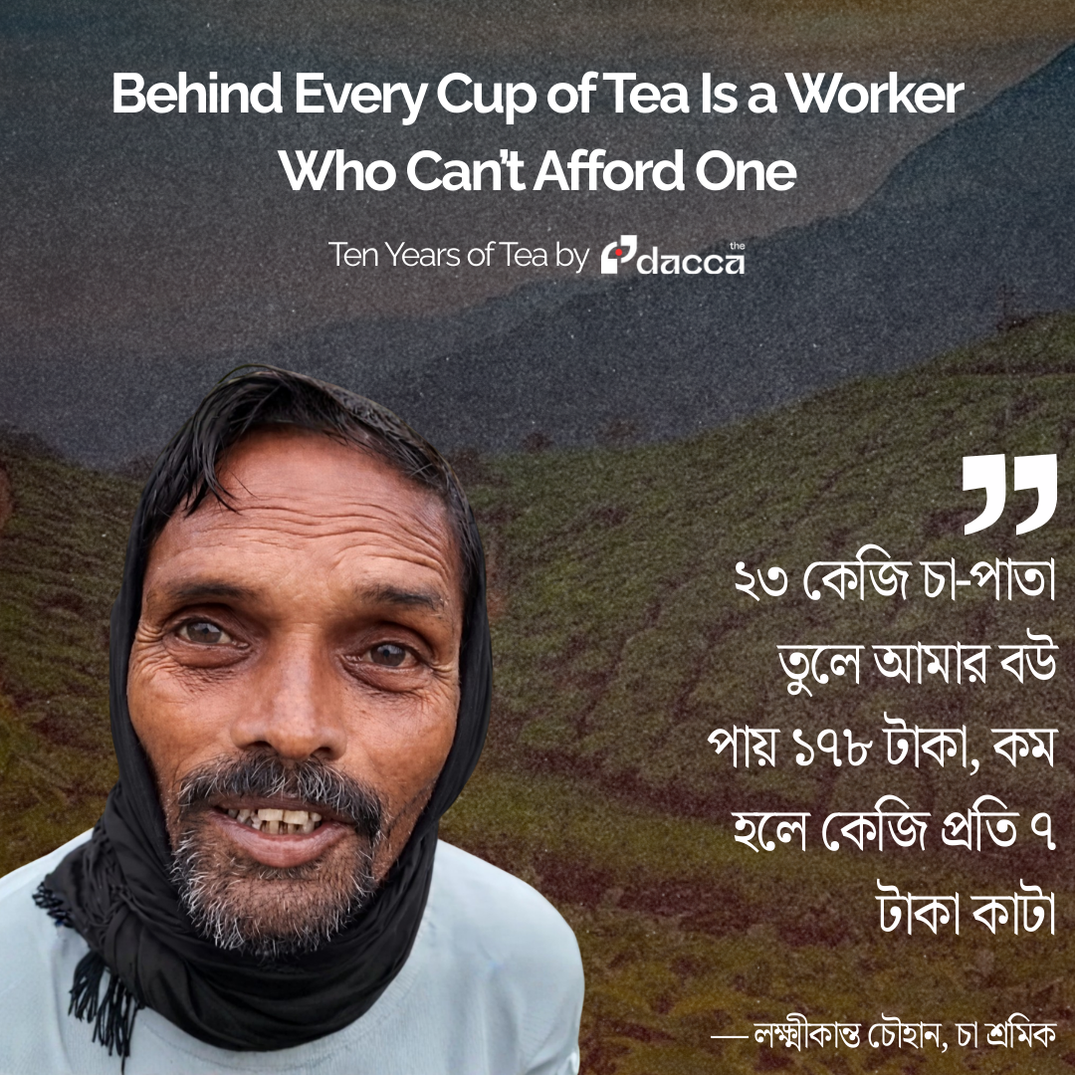
For over a decade, Bangladesh’s tea workers — among the country’s most marginalized labor groups — have repeatedly mobilized to demand fair wages, timely payment of dues, and better living conditions. Despite the industry’s growth in production and exports, labor grievances have persisted, sparking protests across Sylhet, Chattogram, and Habiganj tea estates from 2015 through early 2025.
This is The Dacca’s "Ten Years of Tea," an in-depth analysis of the last decade of news, reports, and videos to understand the struggles and resilience of Bangladesh’s tea workers.
Protests (2022-2025)
August 2022 — National Strike for Wages
- Date: 9–28 August 2022
- Where: Across most tea estates nationwide
- Cause: Tea workers launched a nationwide strike demanding their daily wage be raised from Tk120 to Tk300 amid rising inflation and food prices.
- Scale: Nearly 150,000 workers at over 200 gardens participated.
- Tactics: Two‑hour work abstentions escalated to an indefinite strike, with blockades of highways and plantation roads.
- Outcome: After 20 days of demonstrations, the government intervened; then Prime Minister directed a wage hike to Tk170 per day. Workers largely returned to work thereafter.
September 2024 — Arrears Protest at Kurma & Other Gardens
- Date: Early September 2024
- Location: Kurma and nearby gardens in Moulvibazar
- Cause: Continuous protests demanding due wages, provident fund payments, and other unpaid dues.
- Note: These actions continued even after wage adjustments, highlighting persistent issues with delayed or missing benefits.
October 2024 — NTC Gardens Strike
- Date: From 26 October 2024
- Where: At least 12 state‑owned National Tea Company (NTC) gardens
- Cause: Workers stopped work over six weeks of unpaid wages and rations, forming human chains and road blockades in Habiganj and Sylhet.
- Impact: Strike cut tea operations locally and increased pressure on government and estate authorities.
November–December 2024 — Sylhet Wage & Ration Protests
- Dates: 15 and 30 November 2024
- Where: Sylhet city and estates managed by NTC
- Cause: Workers demanded immediate payment of unpaid wages and rations; leadership called for government intervention to address delays threatening basic survival.
- Voices: Unions warned of starvation conditions for thousands of workers and families.
March–May 2025 — Arrears Protests in Burjan & Other Gardens
- Date: 24 March & early May 2025
- Locations: Burjan Tea Estate (Sylhet), Charagang and Kalagul gardens
- Cause: Workers protested 14–20 weeks of unpaid salaries and rations, citing severe hardship during Ramadan and Eid without pay.
- Actions: Demonstrations outside the Sylhet DC office; plans to blockade major roads.
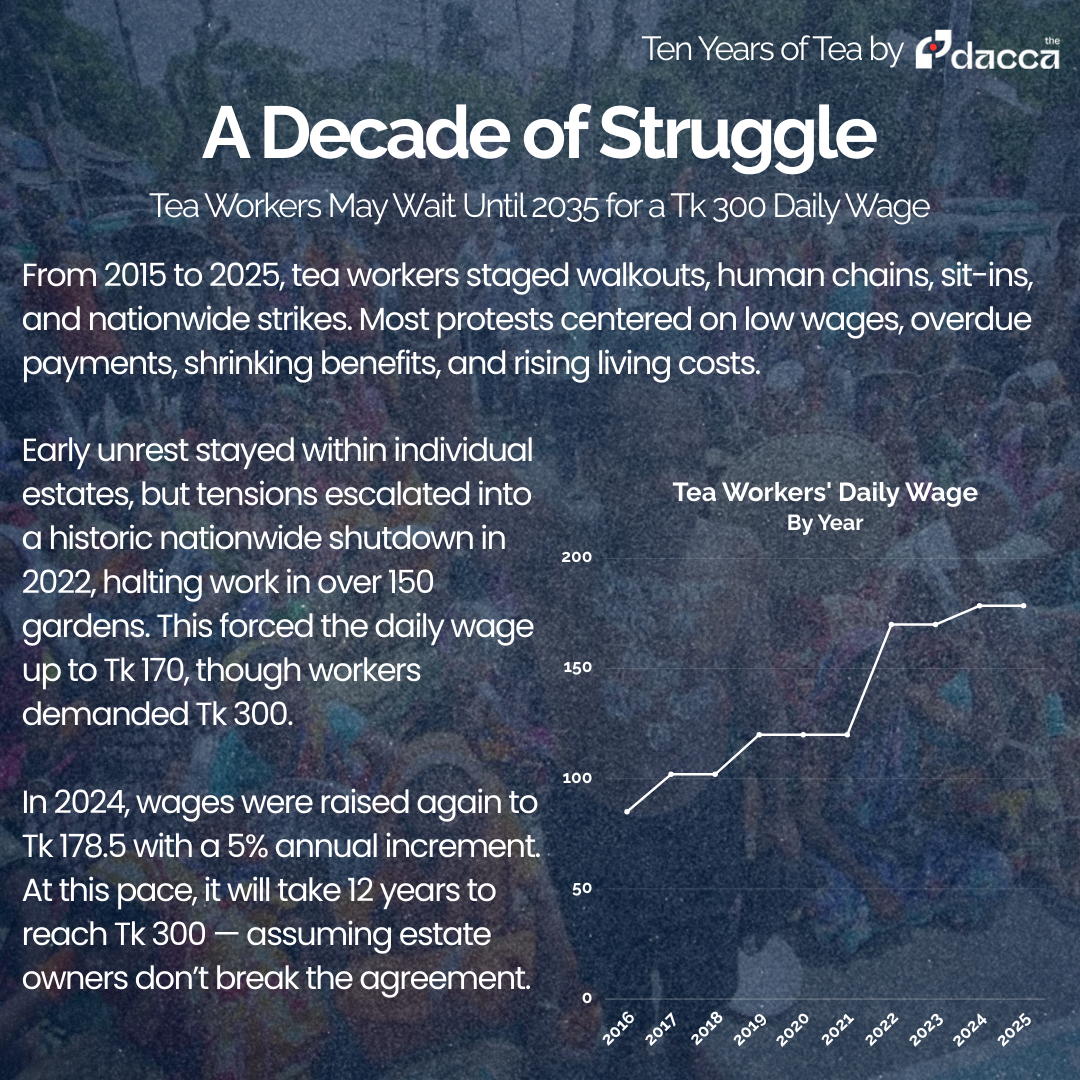
76 Tk Wage Increase in 10 Years
Over the decade, wage improvements have been slow - and often only after significant labour agitation:
| Year | Daily Wage (approx.) | Context / Event |
|---|---|---|
| 2015–2016 | ~Tk102–120 | Persistently low wages; protests were sporadic but not comprehensively archived. |
| 2019–2020 | Tk120 | Negotiated by unions and owners, covering 2019–20; remained low relative to inflation. |
| 2021 | Tk120 | Wage contract extension period; no significant increase despite buyers’ calls. |
| Aug 2022 | Tk170 | After prolonged nationwide protests, the Prime Minister fixed a new minimum wage. |
| Aug 2023 | Tk168–170 | Wage schedule gazetted for tea gardens under categories A/B/C with 5% annual incremental raise (state notification). |
| September 2024- | ~Tk178.5 | Base cash wage remains around Tk170 with annual increments after 2023 structure. |
Unions have often demanded Tk300+ per day, but final settlements have stayed well below expectations.
Non Existent 'Benefits'
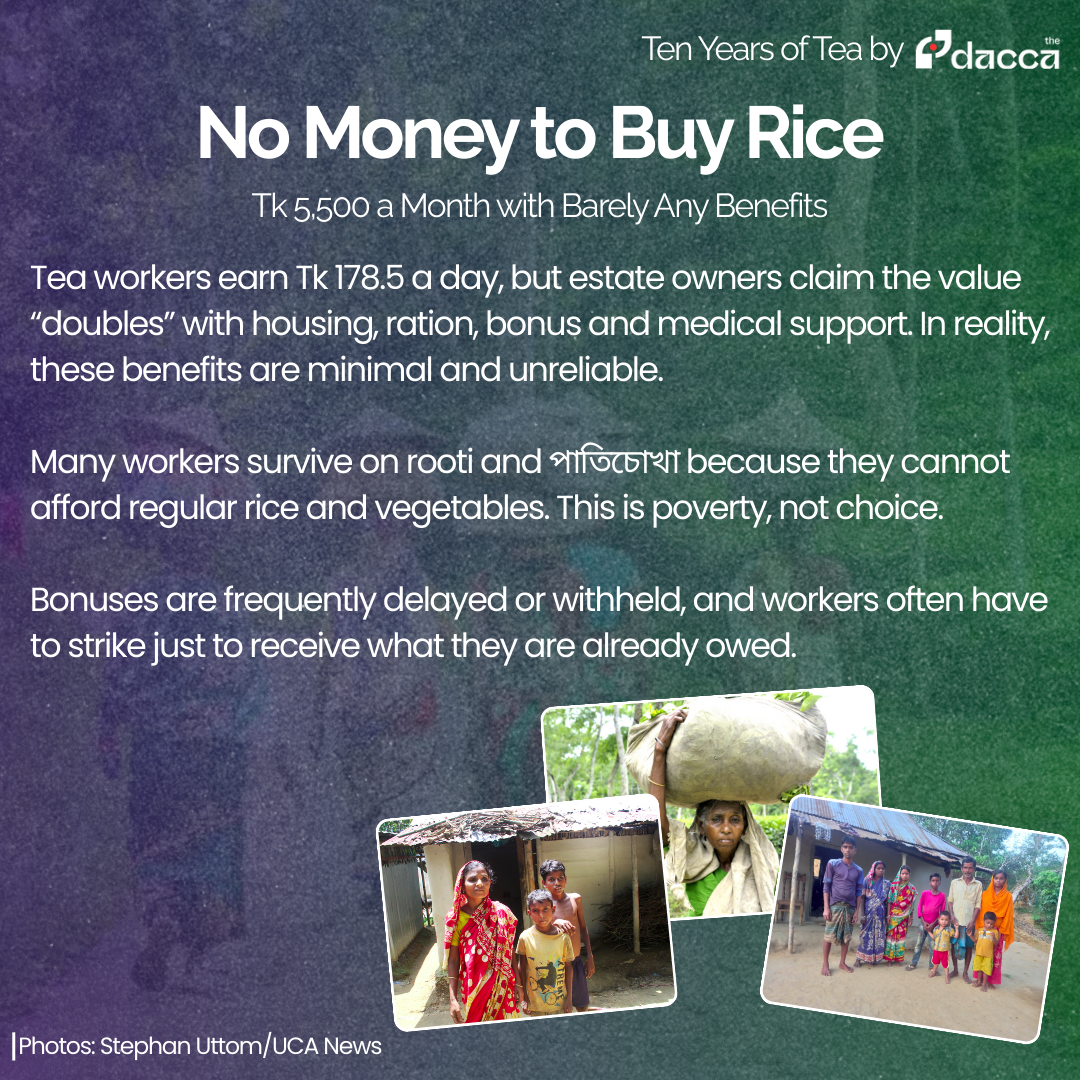
Tea workers in Bangladesh face deep-rooted hardships that stretch far beyond low wages. At estates like Malnicherra in Srimangal, workers live in dilapidated "lines" (labor quarters), lacking basic sanitation, stability and land rights. Many families survive on meager food rations and subsist on loans from neighbors; they often cannot afford enough nutritious food, medical care, or the costs associated with emergencies. Housing is temporary and tied strictly to employment status, meaning non-permanent workers and their families face eviction if they lose their job, compounding long-term insecurity.
Education and healthcare remain gravely neglected in tea garden communities. Schools beyond primary grade five are rare or discouraged. Many children drop out to work in the estates so families can retain their right to reside in tea quarters. This entrenches a cycle of illiteracy and limits social mobility, with only a fraction of children completing secondary education. Basic health services are also inadequate - most dispensaries offer only first aid, compelling families to travel long distances for treatment they often cannot afford.
The historical legacy of the tea industry further deepens marginalization. Many tea workers are descendants of low-caste and indigenous communities brought from India during British rule; they remain socially isolated and face discrimination from the broader society. Workers report restrictions on their movement, lack of cultural autonomy, and a sense of being 'trapped' within estate life with few avenues for escape. This social isolation reinforces economic dependency on employers and weakens the bargaining power of workers.
Structural exploitation in the estates extends to working conditions and labor rights. Workers must meet daily leaf-picking quotas to earn full wages, often working long hours under hazardous conditions without proper protective gear. Enforcement of labor law provisions, including paid leave, welfare officers, mandatory profit share, and safe working environments, is extremely weak. Trade unions are under-resourced and struggle to assert workers’ rights against powerful estate owners with political influence.
The daily struggle of tea workers in Bangladesh cannot be understood through wages alone. A century-old system of economic dependency, social marginalization, lack of education and restricted mobility traps generations in cycles of poverty. Even when wage increases are negotiated, the absence of meaningful access to healthcare, schooling, land rights, and workplace protections means that many tea workers continue to live on the edge of survival. Addressing their plight requires structural reform, effective enforcement of labor rights, and sustained social investment - not just periodic protests or wage revisions.