

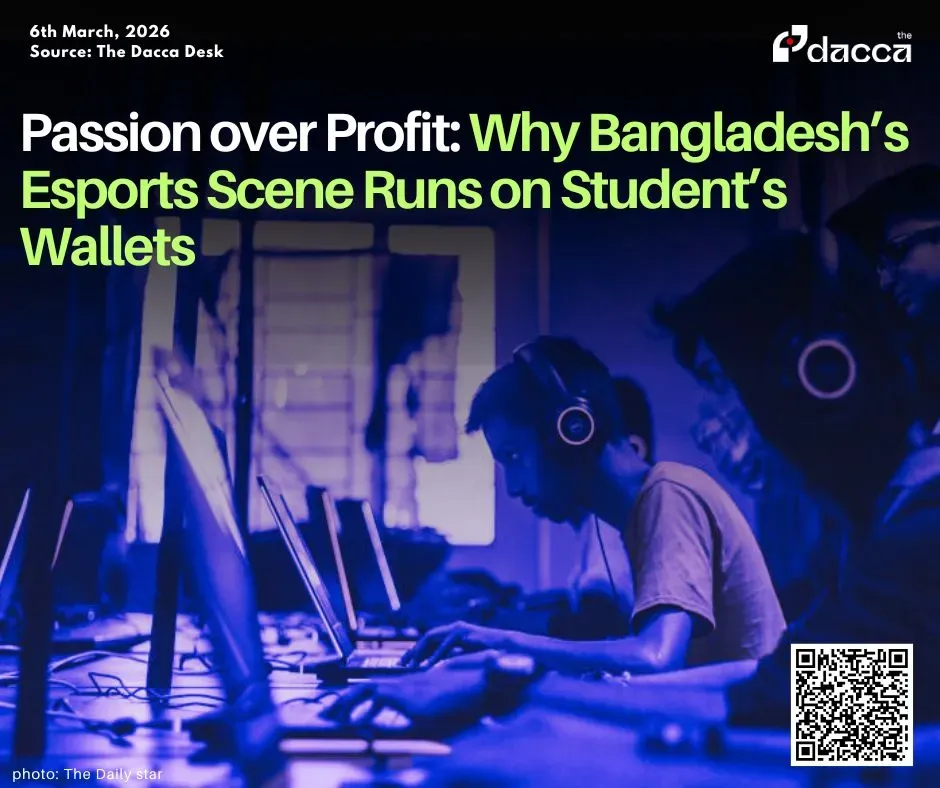
In classrooms across Bangladesh, a digital revolution is quietly unfolding. University students are organizing esports tournaments with little more than passion and personal savings. While the global esports industry has grown into a multi-billion-dollar powerhouse, Bangladesh’s competitive gaming scene remains largely grassroots fueled by enthusiasm rather than institutional backing.
Over the past decade, esports has transformed from a niche hobby into a mainstream spectacle. Countries like South Korea, the United States, and even neighboring India have attracted significant corporate investment, turning competitive gaming into a viable career path. Global esports platform GosuGamers offers grassroots grants up to roughly $400 per event) to tournament organizers, including student clubs in India (Source) . In USA, Some schools and districts receive grants for esports labs or programs (e.g., a $30,000 grant to develop an esports lab) (Source). In Bangladesh, however, the momentum tells a different story. Most tournaments are organized by student clubs or small community groups, often operating without sponsorship or professional infrastructure.
Now the question is why investors are holding back?
One of the key reasons investors remain hesitant is the perception of limited financial return. Many corporate sponsors in Bangladesh still view esports as an entertainment trend rather than a structured industry with measurable growth potential. Unlike cricket or football , sports deeply embedded in the national culture, esports lacks mainstream recognition and consistent media coverage.
Another challenge is the absence of reliable market data. Investors seek clear metrics: audience reach, sponsorship visibility, and monetization strategies. In Bangladesh, many student led tournaments are informal, with limited documentation and marketing analytics. Without hard data on viewership numbers or brand engagement, companies struggle to justify allocating budgets.
As college students we did not have enough experience in esports scene, that was the main reason behind the fact that many top investors such as Gigabyte, MSI turned our offer down.
— Adalur Rahman, President of Scintilla Science Club
Additionally, there is a lack of regulatory clarity. While esports is growing, it is not yet fully recognized as a formal sport in Bangladesh. Without structured governance, standardized tournament rules, and transparent organizational frameworks, large scale corporate investment remains cautious.
The Student Struggle
Behind every local tournament is a group of determined students juggling academic responsibilities and financial pressure. Many organizers fund prize pools from their own pockets. Venue costs, internet upgrades, streaming software, graphics design, and marketing materials all add up quickly. In some cases, organizers rely on entry fees from participants just to break even.
The challenges do not end there. Students often face skepticism from university administrations and parents who see esports as a distraction rather than an opportunity. Securing permission for venues or sponsorship from local businesses can become an uphill battle. A gaming enthusiast Naszid Ahmed Rasin says , ‘I noticed the students of many academic institutions struggle just to reserve a room for gaming events for a single day due to the administration’s neglecting behavior.’
Despite these obstacles, student organizers continue to innovate. Social media platforms serve as their primary marketing tool. Live streams on platforms like Facebook generate modest but loyal audiences. Some tournaments attract hundreds of participants, proving that the interest exists even if funding does not.
Founder of Aurelius Esports , Rejwan Sheikh Sifat aka ‘PRIME’ told The Dacca that, for Bangladesh’s esports ecosystem to mature, collaboration is essential. First, establishing a structured national esports federation with transparent governance could provide legitimacy. Official recognition would encourage corporate confidence and attract media attention.
Second, better data collection is crucial. Tournament organizers should track viewership numbers, engagement statistics, and audience demographics. Presenting clear metrics can demonstrate the marketing value to potential sponsors.
Third, partnerships between universities and tech companies could create campus esports leagues. Universities can provide venues and logistical support, while tech brands gain direct access to a young, digitally engaged audience. Such collaborations would reduce financial burdens on students.
Finally, professionalism in event management must improve. Consistent branding, reliable scheduling, and transparent prize distribution build trust among players and sponsors alike.
Bangladesh has one of the youngest populations in South Asia, with a rapidly expanding digital community. Smartphone penetration and affordable internet packages have already fueled online gaming popularity. The passion is undeniable; what’s missing is structured investment. If corporate sponsors begin to see esports not as a gamble but as a gateway to a digitally native generation, the narrative could shift. With strategic planning, transparent governance, and stronger institutional backing, Bangladesh’s esports scene has the potential to move beyond student wallets and into a sustainable, investor backed industry.
Until then, the country’s esports dream will continue to run on passion powered by the very students who believe in its future the most.