On the afternoon of Sunday, 25 October, Sathi Akter went live on Facebook from her beauty parlour in Bhaluka, Mymensingh. Thieves had cut and taken the electrical wiring from two of her showrooms that morning, and from an air conditioner the month before. She had run the business for 14 years. At one point she said: “I voted for the BNP government, and now I am the sufferer.” (The Daily Star (archive))
Within hours, local BNP activists had gathered in front of her shop. Bhaluka upazila BNP’s joint convener told The Daily Star (archive) that party workers were “angered by her remarks”. At 8:30pm the police took her away “to maintain law and order”. The next afternoon, a Mymensingh magistrate sent her to jail under Section 151 of the Code of Criminal Procedure, a preventive-detention power. No complaint had been filed. The officer in charge of Bhaluka police station said himself that her words were not anti-state. He told Prothom Alo (archive) that he had watched the whole video four times and found nothing critical of the government. He said she was held because she had turned aggressive with traders who came to talk to her after the video spread.
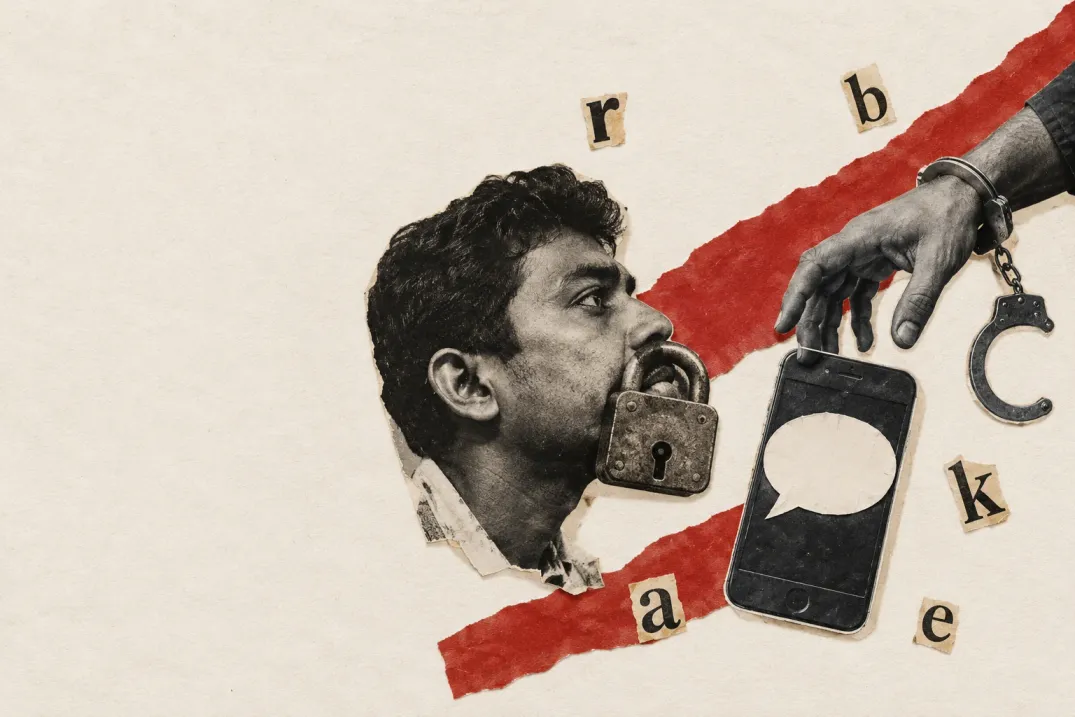
Sathi Akter is one of the latest of at least 30 people arrested since February, in 30 separate incidents, for criticising, mocking or insulting Prime Minister Tarique Rahman, his family, his ministers and MPs, or his government. The Dacca built the record because no one else has. Neither the police nor the government publishes a count, and in September DW Bangla (archive) could find none. We read about 850 news reports published between August 2024 and October 2026, followed each case for bail, jail or release, and compared the BNP’s first eight months with the 18 months of Muhammad Yunus’s interim government before it. What we found:
- Arrests of government critics went from almost none to routine. In 18 months, the interim government arrested two people for criticising Yunus or his government, and three more were sued without arrest. The BNP government has arrested 30 people in 30 separate incidents in eight months, about one a week.
- The ruling party lodges the complaints. Of the 50 people arrested or sued since February for speech against the BNP or its government, at least 18 were reported by a BNP leader or a member of one of its wings: Jubo Dal, Swechchhasebak Dal or Chhatra Dal. In at least ten cases, party activists seized the person and handed them to the police.
- Where the speech is not a crime, the police find another charge. At least seven critics of the prime minister were picked up over a post, then “shown arrested” in an older, unrelated Anti-Terrorism Act or vandalism case. Several of these were cases over Awami League activity.
- The habit began before the BNP took power. While the BNP was not yet in government, people were already being arrested over insults to its leaders, mostly after BNP activists complained or seized them.
We counted arrests and cases over what people said about the government or ruling-party figures. Prosecutions for the activities of the banned Awami League are a separate matter, and we did not count them, unless the person was picked up over criticism and only then booked as a party case.
The prime minister has, on at least one occasion, ordered a detained critic freed. The arrests have continued anyway.
Two in 18 months, then one a week
Under the interim government, arrests for criticising the government were rare. In February 2025, police in Kurigram arrested a Jubo League member over a TikTok video mocking Yunus and the national anthem. In November, police in Parbatipur detained a local Awami League leader over TikTok videos that included the slogan “Yunus hotao, Bangladesh bachao” (“Remove Yunus, save Bangladesh”). Three other people were sued over remarks about Yunus but never arrested. In Kalapara, for example, a man was taken to court for calling the chief adviser “America’s agent”, in a case BBC Bangla questioned (archive) at the time.
That is two arrests in 558 days. Since the BNP government was sworn in on 17 February 2026, there have been 30 in 252 days.
The pace has not slowed as the government settled in. September 2026 was the worst month yet for arrests of the prime minister’s critics. In Gazipur, the college student Sifat Abdullah posted a video (archive) cursing the prime minister over an electricity bill. The rural electricity board later found no irregularity (archive) in the bill. Sifat was refused bail twice. In Gaibandha, Humayun Kabir Duke, 21, was sent to jail under the new cyber law (archive), the Cyber Security Act 2026 (সাইবার সুরক্ষা আইন), which replaced the interim government’s ordinance. In Moulvibazar, Babul Mia, a member of the July Political Prisoners’ Alliance, was arrested on a complaint filed on behalf of the local BNP MP over posts criticising the MP. In Rajshahi, Abu Bokor Siddique commented “only a sniper was missing” under a photo of the prime minister’s bus. He was placed on seven days’ remand under the Anti-Terrorism Act. He told the court it was a joke. We count his case as borderline, because the remark can be read as a threat, and leave it out of our headline numbers.
The complainant is the party
The 2025 Cyber Security Ordinance has a safeguard: only the person harmed by online content, or someone they appoint, may file a complaint. The interim government added it, and Human Rights Watch noted (archive) in April that the rule “seems to have been violated”. The record shows how. The prime minister has not personally complained against anyone. His party’s local leaders have done it instead.
On 26 March, in Muktagachha, Azizul Haque, 35, a Jamaat supporter, shared a doctored photo of the prime minister next to a half-dressed woman. BNP activists protested at the local bazaar that night, and police picked him up at 1:30am under Section 54. The next day a ward-level Swechchhasebak Dal secretary filed a case (archive) under the cyber ordinance and the Anti-Terrorism Act. “I filed it after discussing with local BNP leaders,” he told DW. In Debiganj, a BNP volunteer-wing leader filed against Shakil Ahmed over an image, allegedly made with AI, showing Shakil beside Zaima Rahman, the prime minister’s daughter. A Jubo Dal leader filed against a 16-year-old student over a joke about the local MP. Netra News reported both (archive). Shakil spent 28 days in jail. In Bogura, the upazila BNP president sued Gazi Salahuddin Tanvir (archive), a suspended NCP leader, over a post about the prime minister. Tanvir was held for 41 days, suffered a stroke in custody and later alleged torture.
Sometimes the party skips the complaint. In Sreenagar, Jubo Dal members seized Shaon Mahmud (archive) and handed him to police, who charged him under the Anti-Terrorism Act. In Feni, a Swechchhasebak Dal member handed over Mosleh Uddin (archive) over a post about Zaima Rahman. In Sylhet’s Companiganj, the upazila BNP general secretary delivered Jubayer Ahmad to the police station for writing that a minister had “made our lives hardest”. That night Jubayer was released into the BNP leader’s custody on a signed bond.
Who is protected
The people these arrests protect go well beyond the prime minister. Of the 50 people arrested or sued since February for speech against the BNP or its government, 17 had targeted Tarique Rahman himself. Twenty-five had targeted ministers, state ministers, MPs or advisers. Five had targeted the prime minister’s family: four over posts about his daughter Zaima and one over his late mother, Khaleda Zia. In Bagerhat, police detained a man under the Special Powers Act (archive) over a post about Zaima. In Rangamati, they arrested a man over a post about the home minister’s daughter.
The old-case trick
Sometimes there is no law the speech can be made to fit. Then the police reach for an older case.
Sifat Abdullah was never charged over his electricity-bill video. Gacha police showed him arrested (archive) in an Anti-Terrorism Act case filed in June over an Awami League torch procession. Sifat was not among those named (archive) in it. Three weeks later, police in Sreepur arrested Ashraful Islam Sajal (archive), a local NCP organiser, over another post about the electricity bill. They booked him in a case over an Awami League procession. In Sylhet, the officer in charge told DW (archive) that Mehedi Ahmed, 21, was jailed in a 2024 Anti-Terrorism Act case. His post about the prime minister was “also a reason”, but no case had been filed over it. In Meherpur, Sanjoy Kumar Das was picked up the night his video about load-shedding spread. He was held in a police-filed Anti-Terrorism Act case.
Booking someone in an old case keeps them in jail without a charge a court might throw out. It also keeps the speech itself out of the record.
What the interim government did
The interim government set out to undo the Hasina-era speech cases. In September 2024 the law ministry announced the withdrawal of 1,340 pending “speech offence” cases, and by August 2025 it said 408 had been dropped. Its 2025 ordinance dropped the offence (archive) of spreading “hatred” about the Liberation War, Sheikh Mujibur Rahman, the anthem or the flag. It also added the rule on who may complain. In 18 months, our count finds two people arrested for criticising the chief adviser or his government.
Arrests over insults to BNP leaders did begin on its watch, before the BNP was in government. In March and April 2025, police arrested an Awami League worker over a post about Khaleda Zia, and an imam over a comment about her that a Jubo Dal leader had reported. In December 2025, BNP activists seized a teacher (archive) at Osman Hadi’s grave for calling Tarique Rahman an “extortionist and terrorist”, and he was sent to jail. On that occasion the BNP itself asked for his release. A month later Ain o Salish Kendra condemned (archive) another arrest over remarks about Tarique. In all, police arrested five people over remarks about BNP leaders under the interim government. Most of the complaints came from the party’s activists, before the party controlled the police.
The prime minister’s mercy
On 30 September, police in Kushtia detained Golam Kibria Lalon, a Bangla teacher, after parents protested a remark he had made in class about how long years abroad had affected the prime minister’s Bangla. That night the prime minister’s spokesman Mahdi Amin said Tarique Rahman was upset and had ordered the teacher released “with respect”. The officer in charge drove Lalon home at 11:45pm. In April, the chief whip told parliament (archive) that if anyone had been arrested for drawing a cartoon of him, he wanted them released. Hasan Nasim, jailed over a page that shared such a cartoon (he denies running the page), was granted bail on 21 April.
These interventions came one case at a time. The government’s line has not changed. “Is freedom of expression limitless?” the prime minister’s press secretary asked DW (archive) after the Muktagachha arrest. The BNP standing committee member Ruhul Kabir Rizvi told BBC Bangla (archive) the post “should of course come under the law”. Three weeks after the Kushtia teacher went home, Abu Bokor Siddique was on remand. Four weeks after, Sathi Akter was in jail.
Where they are now
Most of these cases disappear from the news after the first day. For many of the people in our record, the last report has them in jail. We could find no later report of their bail.
The independent count tells the same story. The Human Rights Support Society compared the same six months in both years. It counted (archive) 15 cyber-law cases and 17 arrests in March–August 2025, and 41 cases and 61 arrests in March–August 2026.
The verdict
Muhammad Yunus’s interim government came close to ending the arrest of people for criticising the government: two in 18 months. The habit did not die. It survived in the BNP’s own ranks, where activists were already taking people to the police over insults to their leaders before the party was in government. In February the party took over the state. Its leaders, from ward secretaries to MPs, have since used the police to make insulting the prime minister an arrestable offence again: about once a week for eight months. The prime minister can order one teacher released. He has not ordered the arrests to stop.