


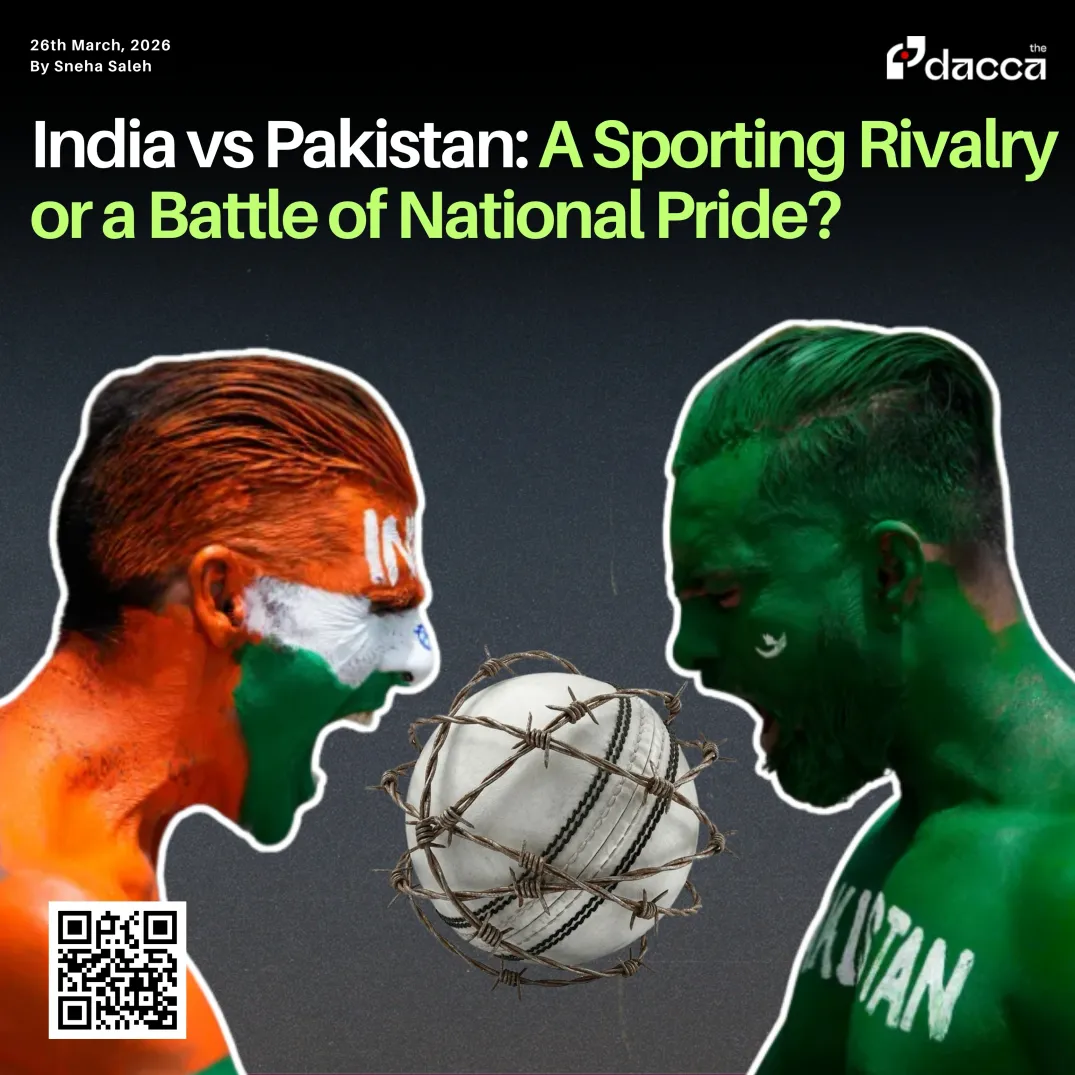
A packed stadium. Breath is held. The bowler starts his run-up. The batsman sends the ball through the covers. The crowd goes wild. The players exchange words on the field. Flags wave. Chants ensue. Emotions run high in the thousands of people in the stands. In a matter of seconds, the drama spreads beyond the boundary rope. What began as a cricket match is now a spectacle for millions of people watching on television and mobile phone screens. When the national teams of India and Pakistan clash, it is not just a cricket match.
There is an element of anticipation associated with these matches, which is not common anywhere else in world sports. Since bilateral series between these teams do not happen often, their matches take place during ICC tournaments. Thus, these matches have a huge significance, making them one of the most viewed events in world cricket.
Over the years, the rivalry has witnessed several notable confrontations. For instance, during the 1992 Cricket World Cup, Javed Miandad (former Pakistan’s batsman) famously taunted the Indian wicketkeeper Kiran More (former India’s wicketkeeper) by repeatedly jumping around the pitch in imitation of the latter’s appeals.
In 2007, Gautam Gambhir (Former Indian Opening batsman and India’s current head coach) and Shahid Afridi (former Pakistan’s most high-profile all-rounder) had a heated argument on the field, prompting the umpire to intervene. In the 2010 Asia Cup, a noticeable argument between Harbhajan Singh (former Indian spinner) and Shoaib Akhtar (former Pakistan’s fast bowler) again highlighted the potential for the rivalry to create intense situations quickly.
Such incidents have not only been reported but repeatedly highlighted by major media outlets including The Indian Express and Economic Times, often grouped under lists of “controversial” or “heated” India vs Pakistan moments. This recurring coverage suggests that confrontations in these matches are more intensely scrutinized and remembered than similar exchanges in other cricketing rivalries.
Such meetings have an element of anticipation unlike any other international sporting event. These matches rarely take place in bilateral series and instead occur in major international competitions sanctioned by the International Cricket Council (ICC). The scarcity of these matches adds to their importance, making them some of the most watched cricket events in the world.
Yet, conflicts in cricket are not unique to these two teams. Bangladesh has had heated moments against Sri Lanka. Australia and England share one of the oldest rivalries in the sport. Disputes, sledging, and emotional reactions are part of competitive cricket.
So why does India–Pakistan feel different?
The answer lies beyond the boundary rope.
Unlike most sporting rivalries, the India–Pakistan contest is shaped by political tension, historical conflict, and religious identity, which influence how both players and fans experience the match.
Public reactions tied to national and emotional wounds
After the 2025 Pahalgam terror attack, the family of a victim publicly criticized the scheduling of an India–Pakistan match, calling it “an insult to those killed.” Such reactions illustrate how, for many, the match is not viewed as sport alone but as something connected to real-world grief and national sentiment.
Political and security tensions shaping cricket discourse
Following security incidents linked to Kashmir, Gautam Gambhir (Former Indian Opening batsman and India’s current head coach) stated that India should not engage in cricket with Pakistan until conditions improve. Statements like this reflect how geopolitical realities influence how matches are perceived.
Religious Symbolism and its Appearance in Public Discussion
In the run-up to the Asia Cup 2025, a Pakistani cricket commentator, Shahnawaz Rana, made a controversial remark suggesting that the Pakistan team could “demolish the Somnath Temple.” The statement circulated widely on social media and was reported by several digital media outlets, drawing criticism for invoking religious symbolism in a sporting context.
There have been other instances where cricket matches between India and Pakistan have been described as a “victory of Islam,” and so on. These instances highlight the presence of religious discussions and ideas in the context of India-Pakistan cricket matches.
Impact on the Game
This environment does not remain outside the stadium; it directly affects the sport itself.
Increased pressure on players
Even players like Inzamam-Ul-Haq (former Pakistan player) have accepted the fact that India-Pakistan matches have “amplified pressure” as the matches are few and far between. They understand the fact that the matches are not just being played at the individual level, but at the national level as well.
There have also been cases where the pressure has resulted in extreme backlash. In the case of India losing to Pakistan during the 2021 ICC T20 World Cup, the Indian bowler, Mohammed Shami, faced online harassment, with the online community calling him a “traitor” and a "Pakistani agent" on his religion.
In a similar case, during the 2022 Asia Cup (super 4 match, 4th September 2022) the Indian cricketer, Arshdeep Singh, faced immense backlash after failing to take a catch during the India-Pakistan match He was labeled a "Khalistani" (referring to a separatist movement) and a "traitor to the nation."
Strain on sportsmanship
During 2025 Asia Cup encounter, players reportedly avoided customary handshakes before or after the match. Such moments, though rare, have been interpreted as signs of political tension spilling into on-field behavior.
The effect of fan involvement in increasing rivalry
The reactions from fans can further escalate the situation. In the run-up to the 2025 Champions Trophy, there were social media campaigns asking cricketers to refrain from engaging in friendly gestures such as hugging an opponent, as done by Virat Kohli.
More Than Just Cricket?
The India-Pakistan rivalry takes place in a domain in which sports, identity, and emotion converge. Although the game itself is subject to the same rules as any other international sports contest, the surrounding context changes the way the game is received, not only by the players on the field but also by the fans in the stands.
It is this amalgamation of history, politics, religion, and emotion, therefore, which takes the India-Pakistan rivalry beyond the ordinary sports contest. The events on the field may only take a few hours, but their implications go far beyond the scoreboard.
Commercial and Media Forces Amplifying the Rivalry
The commercial and media environment in the India-Pakistan rivalry further adds to the intensity of the rivalry. The India-Pakistan clash at the 2019 ICC Cricket World Cup, for example, garnered approximately 273 million viewers worldwide, with Star India broadcasting the event, and estimates suggest that the total worldwide figure may be as high as 400 million, making it one of the largest cricket matches ever. Commentator Harsha Bhogle has gone on record to repeatedly assert that matches like the India-Pakistan clash are arguably one of the most commercially significant cricket matches, and former ICC Chief Executive David Richardson termed them as “marquee fixtures” that are crucial for cricket’s global outreach. The media’s role in the India-Pakistan rivalry is also significant, as the language and rhetoric employed to describe the matches are akin to warfare, with the use of terms like “battle” and “revenge.” Media, War & Conflict, a journal, has also pointed out the use of quasi-military rhetoric to describe matches like India-Pakistan.
Criticism as a Catalyst for Performance
Even though matches against Pakistan may put the players in a tough spot, in many cases, the backlash from the public has actually ended up acting as a motivational factor for the players rather than a demoralizing factor. For instance, during the T20 World Cup 2021 in Dubai, India suffered a heavy defeat against Pakistan in the tournament. Mohammed Shami was subjected to a lot of backlashes and hate comments on social media for his poor performance against Pakistan and was targeted for his religion too. However, Shami was able to regain his form in the following years and emerged as the leading wicket-taker for India in the 2023 ODI World Cup.
On the Pakistani side, fast bowler legend Shoaib Akhtar in many interviews and sports programs, has repeatedly stressed the fact that “there’s extra adrenaline when you are playing an India-Pakistan match. If you perform in India-Pakistan matches, you become a hero overnight.” Similarly, when Sachin Tendulkar (former Indian top-order batter) wrote in his autobiography *Playing It My Way* and in subsequent interviews about the experience playing against Pakistan in the 2003 Cricket World Cup, he said, “There’s always pressure when you play Pakistan, but I tried to treat it like any other match and focus on preparation.” These quotes and examples, in aggregate, show that while there are immense scrutiny and emotional backlash in India-Pakistan cricket matches, there are examples from players on both sides that show that the pressure and criticism were turned into performance and success.
On the field, it is like every other game, with the same rules and regulations applying to every match, and a single ball or misplaced shot capable of turning the tide of the game in an instant. Off the field, it is like something bigger—almost like the definition that Carl von Clausewitz (a Prussian military strategist) gave to war when he said that “War is the continuation of politics by other means.” Cricket and war may be a long way apart, but the language and symbolism that accompany the former may evoke the latter. Yet the game still manages to produce moments that transcend it all. As Wasim Akram (former Pakistani fast bowler) once said of India-Pakistan matches, “It’s a game of pressure and passion,” and yet it is in that pressure that the opportunity for greatness is born. It may be that the rivalry is best understood as a theatre, with history providing the stage and politics providing part of the script, but with the players still making it up as they go along and writing the final scene themselves. It is not quite a sporting contest and not quite a battle of national pride, but rather a mixture of the two. It may be that it is a game and it may be that it is more than a game, depending on the perspective that is chosen to view it from. And so long as the excitement builds and the emotions run high and the millions continue to watch, the answer to the question may be just as interesting as the rivalry that it seeks to explain.