

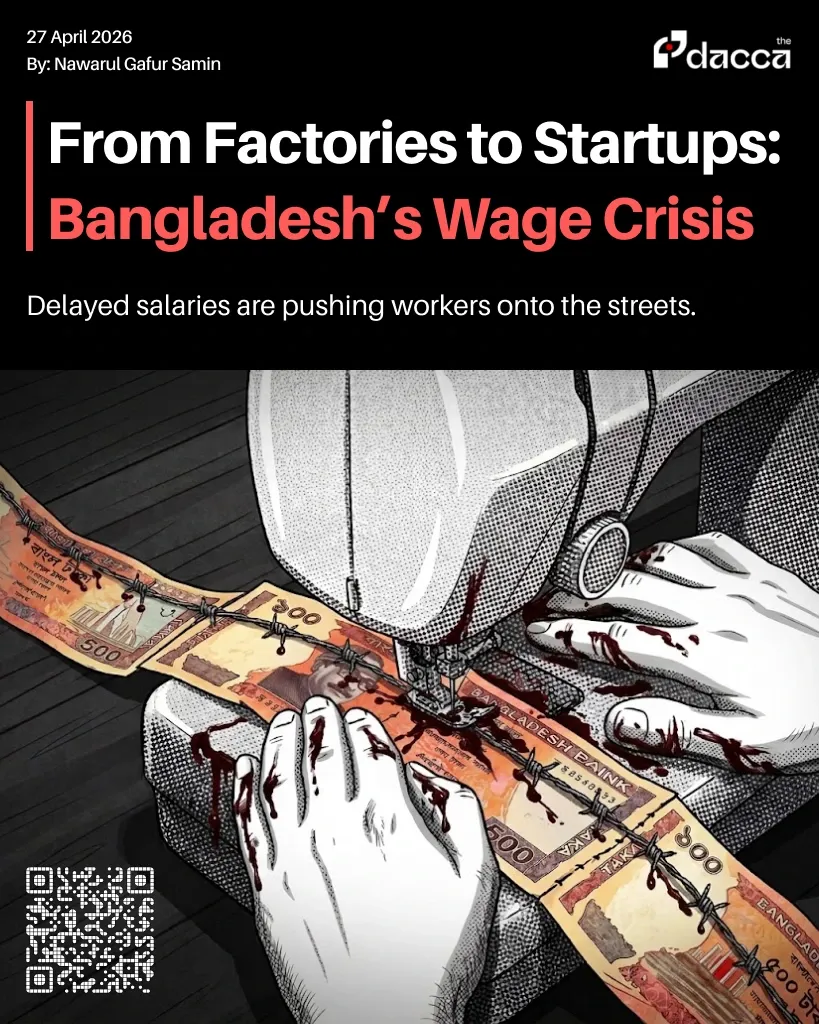
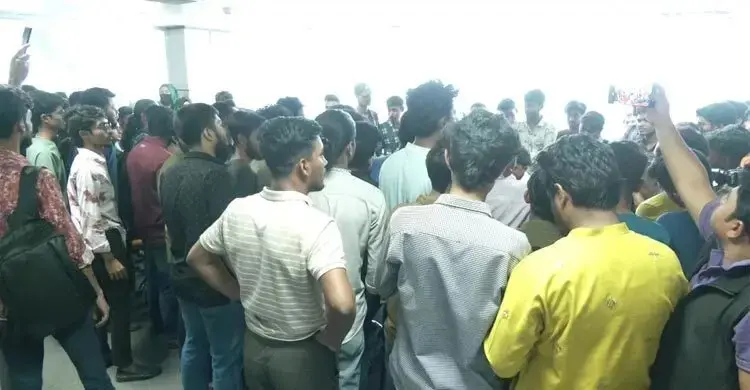
Every now and then, Dhaka’s traffic-alert Facebook groups break from their usual rhythm of gridlock updates and road closures. A post appears about a blockade. Then another. A short video follows: workers in the street, horns blaring, cars at a standstill, anger building in real time.
It is easy to feel annoyed in the moment. It is harder to ask why the roads are blocked at all. This Eid, workers from nearly 122 garment factories spent the holiday without receiving their salaries for the month. Out of 9,695 industrial factories across the country, only 6,673 had paid Eid bonuses, while March wages remained unpaid in 7,860 factories, according to industrial police data. For millions of workers, the most celebratory time of the year arrived without a paycheck.
But this is not a garment sector problem alone. Last month, Chaldal employees stormed their offices in Jashore, demanding wages that had gone unpaid for months. Chaldal's case is instructive precisely because it sits at the other end of Bangladesh's economic ambition: a homegrown tech venture that once symbolised a new kind of employer. When wages go unpaid there too, it becomes harder to treat this as a manufacturing pathology. From conglomerates to media houses, delayed wages have become a quiet crisis cutting across Bangladesh's entire economy.
So why does this keep happening? The reasons vary by sector, but the pattern is consistent. In factories, wages are often paid from the following month's export receipts, meaning a delayed shipment or a slow letter of credit clearance is enough to push an entire payroll off schedule. In startups like Chaldal, the culprit is different: the global funding drought that followed 2022 hit South Asian ventures hard, and wages became one of the first casualties of the dwindling runway. In both cases, what gets absorbed first is the worker's certainty: their ability to plan, to pay rent, and to buy their children new clothes.
Bangladesh's laws are unambiguous on paper. The Labour Act requires wages to be paid within seven working days of the month's end, with penalties prescribed for non-compliance. Yet the law's clarity has done little to change employer behaviour, because enforcement remains the missing piece. Industrial police dutifully track the numbers, as the data above shows, but meaningful consequences for non-compliant employers are rare. Factory owners who withhold wages face, in most cases, very little.
Bangladesh ranks among the ten worst countries in the world for working people, according to the International Trade Union Confederation. The irony is not lost: last year, Bangladesh made history as the first Asian country to ratify all eleven fundamental ILO instruments, a milestone celebrated by the interim government as a signal of its commitment to labour rights. Bangladesh has signed its way to the front of the room. What it has not signed are the two conventions that would require it to actually pay workers — Convention No. 95 on the Protection of Wages, and Convention No. 131 on Minimum Wage Fixing. It has moved on safety, health, and harassment. On the question of workers simply being paid, it has not.
The data has a name. Joynal, a labour leader from Uttara, spoke to The Dacca on behalf of 280 workers at Amena Fashion. "One Eid is gone and another Eid is almost here," he said, "but the workers' Eid wages are yet to be paid." During Ramadan, his workers had negotiated a deal with the factory owners under BGMEA’s mediation–committing management to clear outstanding dues within the first week of every month. It was a modest ask. Prices had been climbing, and the workers needed some certainty. When we spoke to Joynal, February's wages had still not come. On April 20, they were told they'd be paid. They were not.
The path forward isn't complicated. it requires inspectors with actual authority to impose actual consequences, but it demands political will that has, so far, not materialised. Bangladesh has signed the declarations, published the data, and passed the laws. It has done, in other words, everything except enforce them. What Joynal's fellow workers are living through is not a failure of legislation or a gap in the rulebook: it is the entirely predictable outcome of a system that was never seriously designed to hold employers to account. The traffic jams were not an anomaly. They were the system working as intended