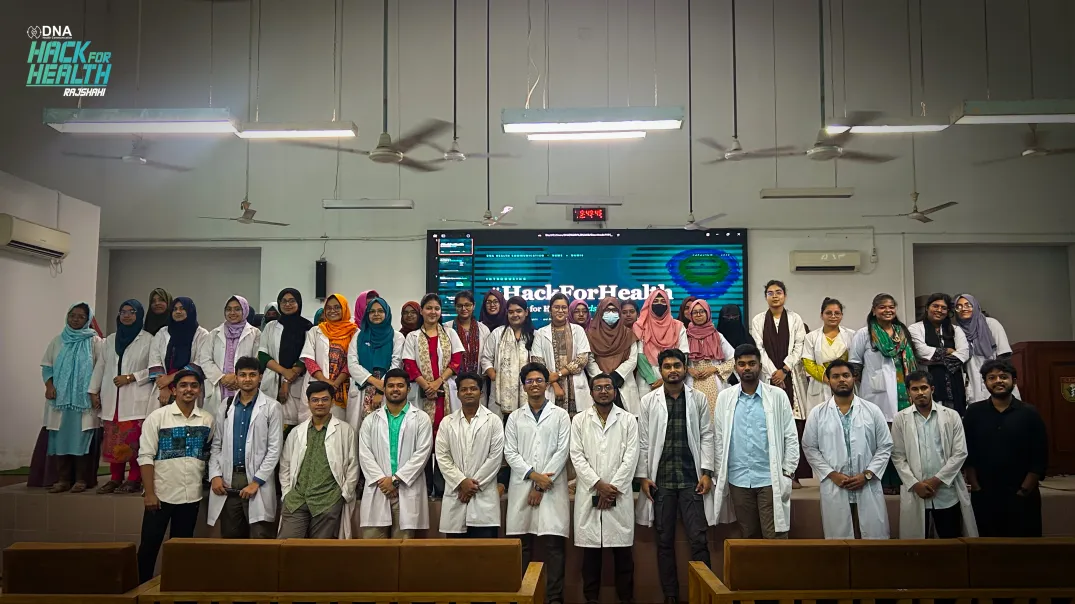
The journey of DNA Hack For Health 2026 has now reached northern Bangladesh. Following two successful divisional editions in Sylhet and Chattogram, DNA Health Communication officially launched the Rajshahi Division chapter through a Hackathon Warm-Up Session held today at Shaheed Ziaur Rahman Medical College Hospital (SZRMC), Bogura, in collaboration with IMSEN Bangladesh.
Beginning at 9:00 AM, the session brought together medical students, faculty members and aspiring innovators for an intensive introduction to Bangladesh's growing health-tech movement. More than a ceremonial launch, the programme served as a practical orientation for participants ahead of the Rajshahi Divisional Hackathon, where students will compete to solve real-world healthcare challenges using technology and innovation.
Throughout the session, organisers introduced participants to the vision behind DNA Hack For Health, explained the competition structure and explored ten digital healthcare missions covering Health FinTech, Smart Pharmacy, AI-powered Telehealth, Mental Health, FemTech, Elder Care Technology, Fitness and Nutrition, Medical EdTech, Smart ICU systems and Healthcare Infrastructure. The interactive Q&A session saw enthusiastic participation from students, with many expressing their intention to register for the competition.
The warm-up session also reinforced one of the movement's central messages: Bangladesh's future healthcare system cannot rely solely on doctors. Organisers highlighted the need for closer collaboration between the Ministry of Health and the Ministry of Education to encourage multidisciplinary careers where clinicians work alongside engineers, software developers, finance professionals and data scientists. As healthcare becomes increasingly technology-driven, the movement argues that innovation must begin from the first year of university education.
Rajshahi now joins a movement that has already produced promising innovations elsewhere in the country. In Sylhet, champion team NeuroNurture developed an AI-assisted autism detection platform, while Team Star created a VR-based training solution for grassroots midwives and MediLink designed a real-time emergency logistics platform for ICU beds and critical medicines.
The benchmark rose even higher in Chattogram, where champion team Hemo Hackers developed an AI-powered smartphone solution capable of estimating blood haemoglobin levels from fingertip videos. Runner-up Rhetoric Minds introduced an offline QR-based emergency health identity system, while Second Runner-Up Arekta Team built an AI-driven rehabilitation platform for stroke and Parkinson's patients.
With the Rajshahi chapter now underway, organisers say the challenge for the region's young innovators is to build upon — and potentially surpass — the achievements of previous divisions.
The Rajshahi Divisional Hackathon will begin with preliminary rounds focused on solving local healthcare problems. Winning teams will advance through the divisional finals before representing Rajshahi Division at the National Grand Finale in Dhaka, where Bangladesh's most promising healthcare innovators will compete on a national stage.
DNA Hack For Health Expands to Rajshahi Division with SZRMC Warm-Up Session