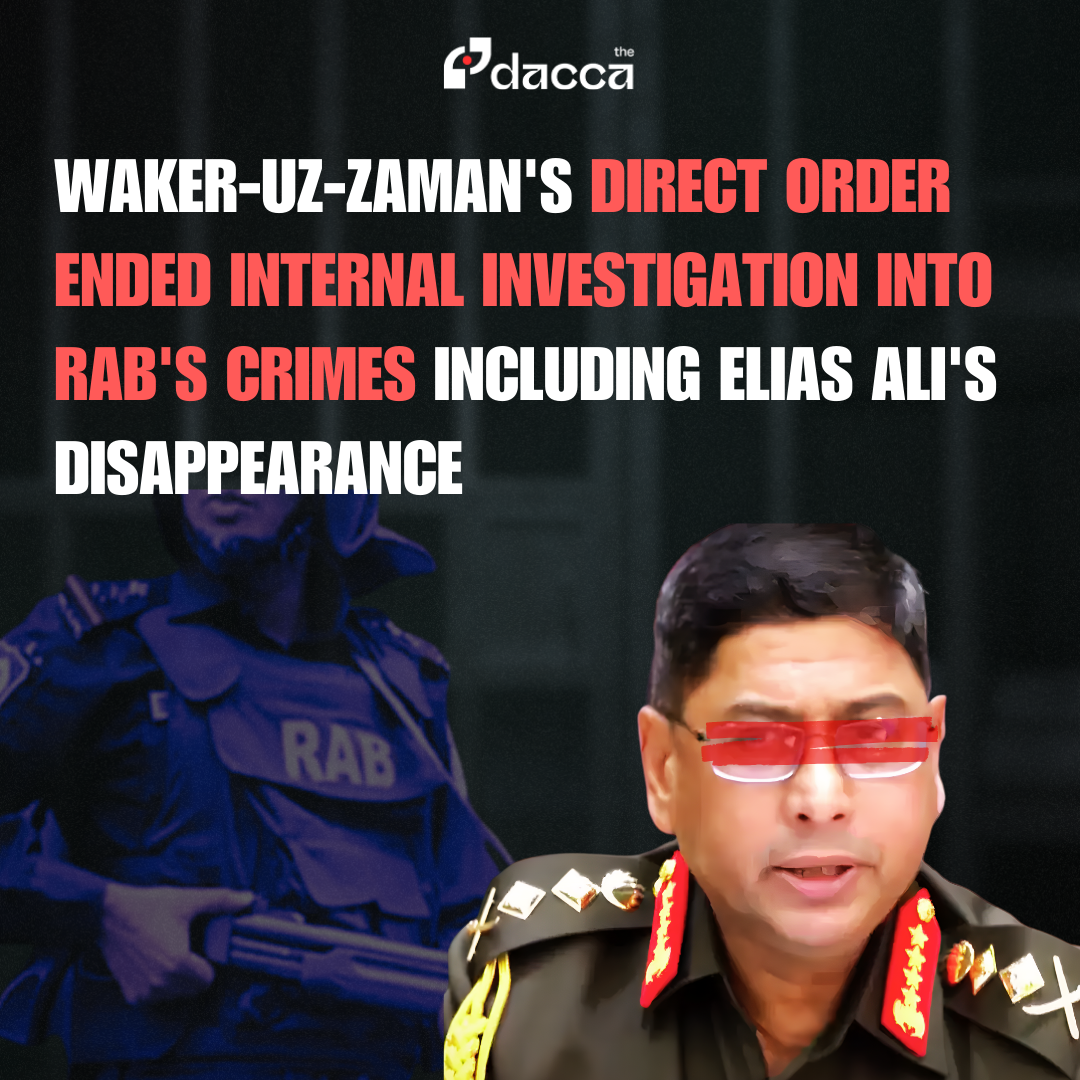
The Dacca has obtained portions of the Commission of Inquiry on Enforced Disappearances' final report, revealing that Army Chief Gen. Waker-uz-Zaman personally intervened to shut down an internal military investigation into enforced disappearances, including the case of missing BNP leader Elias Ali.
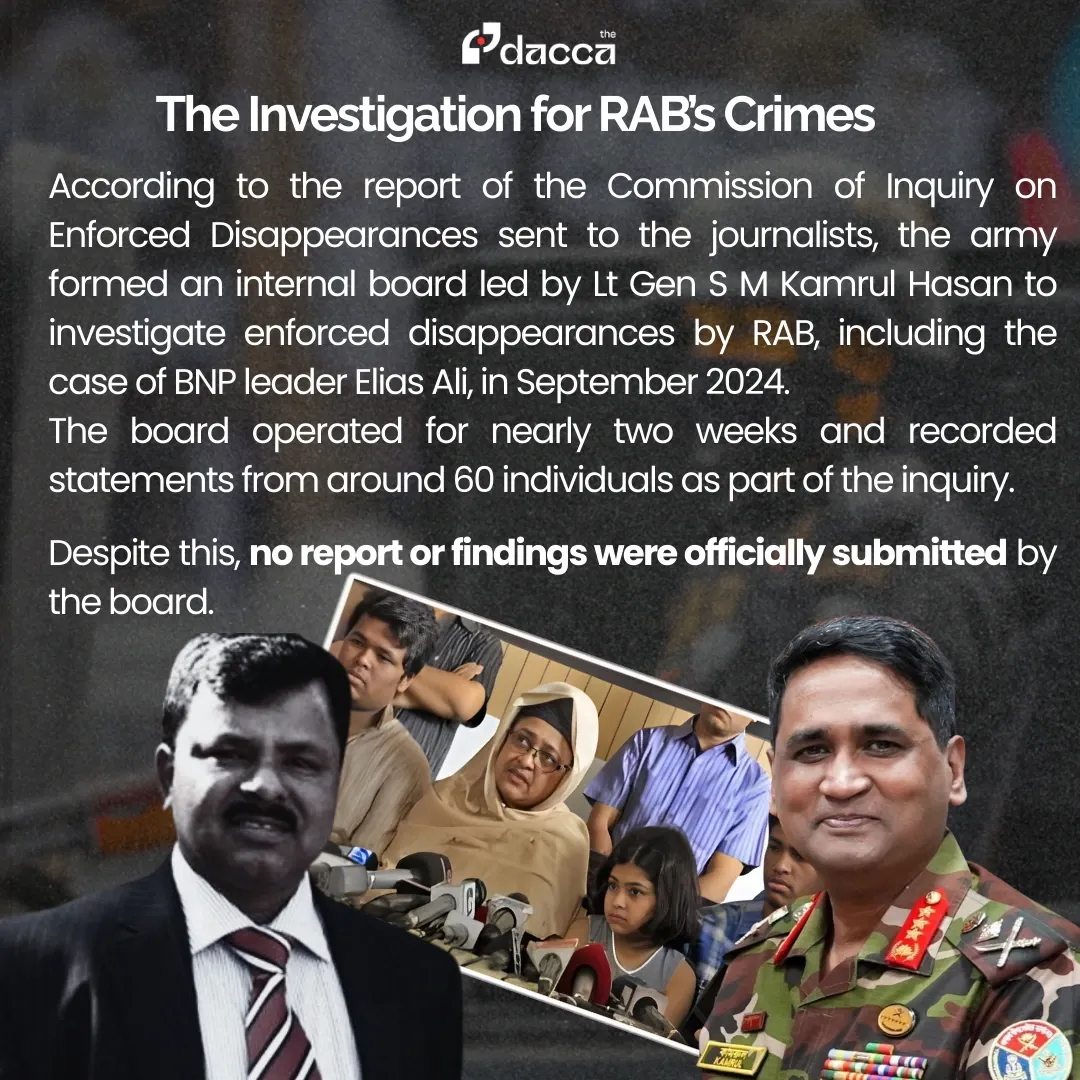
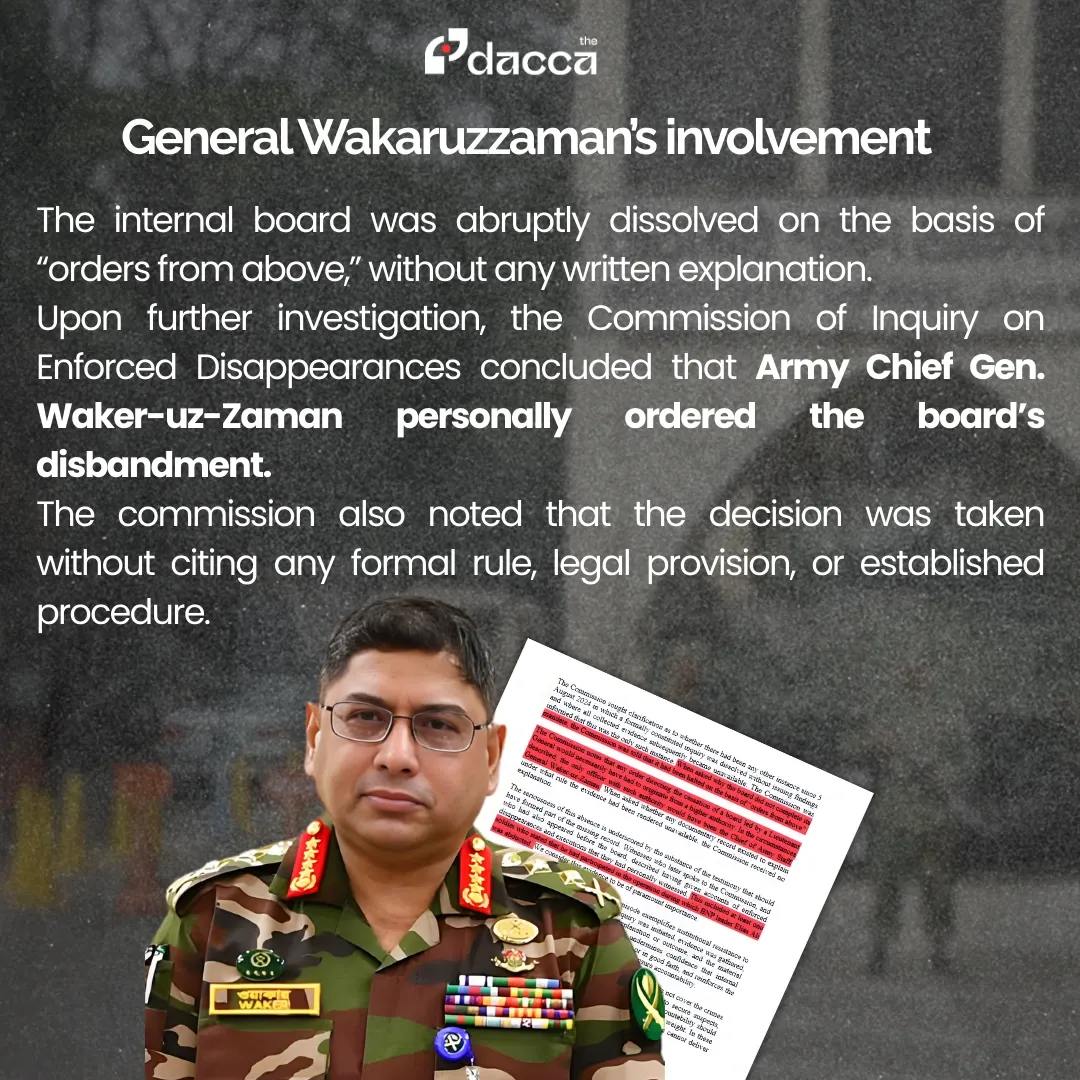
In September 2024, the army established an internal board led by Lt Gen S M Kamrul Hasan to examine Elias Ali's disappearance. Over two weeks, the board recorded statements from approximately 60 individuals. However, the investigation was abruptly dissolved on grounds of "orders from above" without formal procedure. The commission concluded that Gen. Wakaruzzaman personally issued the disbandment order. It writes, “...any order directing the cessation of a board led by a Lieutenant General would necessarily have had to originate from a higher authority. In the circumstances described, the only officer with such authority would have been the Chief of Army Staff, General Waker-uz-Zaman.”
The commission's report details the military's response to the inquiry, covering jurisdictional questions and legal objections. Crucially, They collected testimonies demonstrating senior-level knowledge, oversight, and engagement with detention sites spanning multiple years.
Victim accounts revealed organized operations between agencies. DGFI used thicker blindfold cloth while RAB employed thinner material, sometimes allowing victims limited vision during transfers. The commission deemed this significant—different units maintained distinct equipment reclaimed after custody periods. Such transfers required prior communication, agreed locations, and mutual recognition between units, demonstrating deliberate coordination rather than informal arrangements.
Unlike other government branches, armed forces haven't adopted the PLR system. Lt Gen Akbar's Leave Pending Retirement ran from November 2023 to November 2024, giving authorities nearly two months to prosecute him before formal retirement. No action was taken.
The Commission of Inquiry on Enforced Disappearances (Chapter 12.5.3)
In early September 2024, at the same time that the Army constituted a Court of Inquiry to examine the abduction of Brigadier Azmi, another internal board was established to inquire into the alleged crimes committed by RAB, including enforced disappearance and extrajudicial killings, with a particular focus on the case of BNP leader Ilias Ali. The board was led by Lt General S. M. Kamrul Hasan and included the following members: Major General Iftekhar Anis; Major General Md Naheed Asgar; Brigadier Mohammad Monour Hossain Khan; Brigadier Mohammad Abdur Rahman; and Brigadier Md Asif Iqbal.
At the same time, a third internal board was constituted to investigate corruption. The chair of that board, Lt General Mizanur Rahman Shameem, confirmed its existence to the Commission.
The board on RAB operated for about two weeks. During this period, it interviewed a large number of officers and soldiers, potentially numbering up to sixty individuals, although exact numbers remain unclear. Multiple witnesses later informed the Commission that their depositions were formally recorded at that board. Some stated that audio recorders were placed in front of them, others reported the presence of video cameras, and several indicated that they were asked to sign written statements. The Commission therefore has no doubt that evidence was systematically collected during the inquiry.
BA 3799 Brigadier Rashidul Alam, who was RAB 1 CO (2009–2013) at the time BNP leader Ilias Ali disappeared from Banani, informed the Commission:
"I was called over telephone. To me, it seemed to be a board of officer for the fact-finding… They asked me exclusively on what I know about Lt Gen Mujib and his involvement in Elias Ali case. Here also I tried my best to give them full detail of involvement of Major General Zia in Elias Ali case. I gave one written statement and the board most probably recorded my statement because I saw an audio recorder in front of me. I just marked it."
Despite this, the Commission has been unable to trace any report produced by the board. When contacted, the chair of the board stated that it was disbanded without reaching any resolution. When the Commission requested access to the evidence collected during the inquiry, it was informed that the same was no longer available. This account was independently corroborated by the Director of the Personnel Services Directorate under the Adjutant General’s Branch at Bangladesh Army Headquarters, who served as the Commission’s focal point.
The Commission sought clarification as to whether there had been any other instance since 5 August 2024 in which a formally constituted inquiry was dissolved without issuing findings and where all collected evidence subsequently became unavailable. The Commission was informed that this was the only such instance.
When asked why the board did not complete its mandate, the Commission was told that it had been halted on the basis of “orders from above.” The Commission notes that any order directing the cessation of a board led by a Lieutenant General would necessarily have had to originate from a higher authority. In the circumstances described, the only officer with such authority would have been the Chief of Army Staff, General Waker-uz-Zaman.
When asked whether any documentary record existed to explain under what rule the evidence had been rendered unavailable, the Commission received no explanation.
National media outlets have maintained complete silence on these findings, with observers suggesting pressure from military authorities to suppress coverage.