


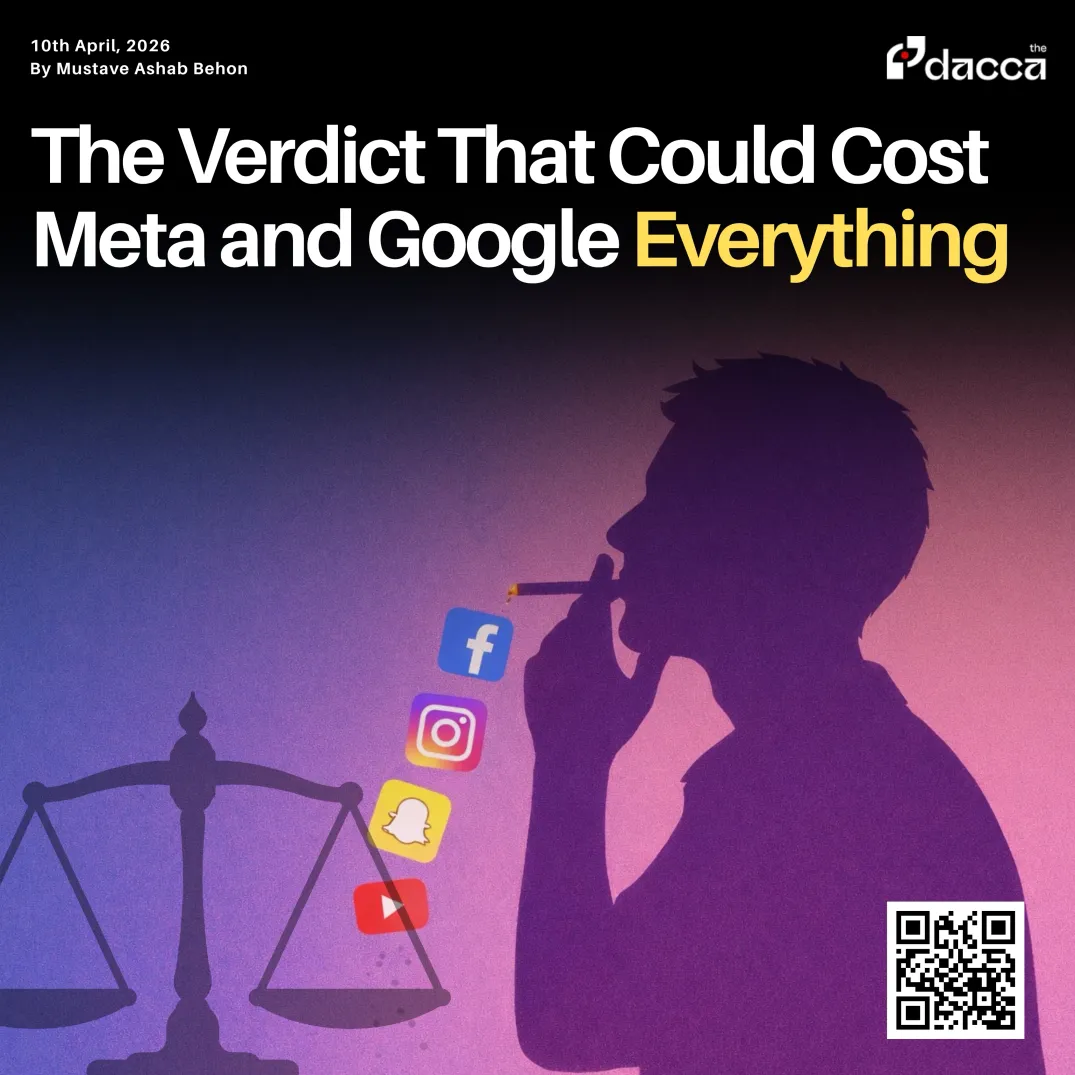
For decades, Big Tech operated with a simple defence: we are just the platform. What users do, what they feel, what they become — that is not our responsibility. That defence just cracked. A Los Angeles jury has found Meta and Google legally liable for the way their apps were designed — and with over 10,000 similar cases waiting in line, the question is no longer whether social media companies will be held accountable. The question is what that accountability will actually cost them.
On March 25, 2026, a Los Angeles jury found Meta and Google — the parent companies of Instagram and YouTube — liable for the mental health disruption of a 20-year-old girl referred to as KGM, or Kaley. In February, Kaley had testified that her early introduction to social media triggered her addiction to technology and exacerbated her depression and suicidal thoughts. She added that she developed body dysmorphia — a clinical condition diagnosed by doctors — as a result. Kaley told the trial she had started using YouTube at the age of 6 and Instagram at the age of 9. By the time she completed elementary school, she had already posted 284 videos on YouTube alone. Her lawyers argued the social media companies were liable for their addictive designs. They pointed to notifications, which would give Kaley a "rush" — she added that she used to go to the toilet during class just to check them. She also used to buy likes from a platform, which gave her a feeling of being popular. The plaintiff also said she used filters to alter her cosmetic appearance in almost all of her photos, which she said led to her body dysmorphia — she had not experienced negative thoughts about her appearance before using filters. One of her therapists, whom she had worked with for six months in 2019, testified that what happened on social media used to directly influence her mental health. Though the defendants argued none of her therapists claimed social media as the main reason behind her mental health damage.
The jury ordered the companies to pay $3 million in compensatory damages and an additional $3 million in punitive damages. Jurors found Meta was 70% responsible for her mental health damage and YouTube 30%. TikTok and Snapchat were part of this trial but reached an undisclosed settlement with the plaintiff before the trial began.
The jury ruled that Section 230 did not apply in this case because the case targeted app design features — like infinite scrolling, autoplay, and algorithmic recommendations — rather than content. Section 230 treats platforms as neutral hosts rather than publishers of content, and companies had long used this law as a liability shield. However, in a report from TechBrew, Eric Goldman, a law professor at Santa Clara University, argued that Section 230 should still have applied. He argued, "When plaintiffs claim they are 'addicted', what are they addicted to? The answer is third-party content."
Neither of the companies has agreed with the verdict and both are appealing the decision. Separately, a New Mexico jury found Meta liable and ordered it to pay $375 million for failing to prevent child sexual exploitation on its platforms, with demands for better real age verification tools. The LA case is significant as it was the first time a lawsuit successfully bypassed Section 230 and ruled against these companies — and there are over 10,000 similar cases still to be decided in the US alone.
The lawyers for Google and Meta claimed the plaintiff used these platforms as a coping mechanism for already existing mental health struggles. During the trial, Meta lawyer Phyllis Jones showed jurors text exchanges and Instagram posts in which Kaley discussed her mental health and her turbulent relationship with her mother, and played videos Kaley had recorded of her mother yelling at her. The plaintiff acknowledged that their relationship was difficult — and the fact that Kaley currently lives with her mother lends further support to the defendants' argument. A Meta spokesperson argued that teen mental health is "profoundly complex and cannot be linked to a single app." Google spokesperson Jose Castañeda said the verdict misrepresents YouTube as "a responsibly built streaming platform, not a social media site."
A Big Tobacco moment for Big Tech?
The jury found Meta and Google negligent in their design, ruling it was a "substantial factor" in the harm caused to the plaintiff, and held the companies liable for failing to adequately warn users about the dangers of using Instagram and YouTube. This brings us to the question of whether this will become the Big Tobacco Moment for the tech industry. The Big Tobacco Moment refers to the 1998 Tobacco Master Settlement Agreement, which led tobacco companies to stop promoting their products to minors and caused a significant drop in the smoking rate among people under 18. The companies were also forced to pay billions of dollars, which went into state Medicaid funds for treating smoking-related illnesses and into smoking prevention programs. CNBC has referred to this LA verdict as the social media industry's "Big Tobacco" moment.
This LA verdict was the first bellwether case to reach a jury decision. A bellwether case is a representative trial chosen from a large pool of similar lawsuits to act as a test case — tried first to help both sides guess how a jury might react to specific evidence and arguments, and to provide a roadmap for the thousands of similar claims that follow. There are at least 20 more bellwether cases scheduled for trial on this topic. The next bellwether case, brought by a teen boy, is set to go to trial later this year. This raises the question: if most of these cases go in favour of the plaintiffs, will they even matter to the social media companies?
Jonathan Haidt, social psychologist and author of The Anxious Generation, told CNN, "You add it all up and it could be hundreds of billions of dollars. That, I think, would get Meta's attention, and I think that would possibly cause them to change their behavior." TechBrew explains, "With over 2,000 similar suits pending, the damages could stack up fast — punitive awards in this case considered the companies' net worth, which the judge said was equal to each company's total stockholders' equity ($217 billion for Meta, $415 billion for Google). If other juries follow suit, the industry could face billions in liability — reason enough to rethink how they design for young users."
This LA verdict signals to users that juries are willing to hold social media platforms accountable for their design features. With over 10,000 cases remaining and the LA verdict serving as the bellwether, plaintiffs across the country have renewed hope of winning on their own. While the verdict has not forced any design changes yet — and may be reduced or overturned on appeal — the question remains: will these companies change their policies before future rulings potentially cost them billions, purely for liability over design choices?