


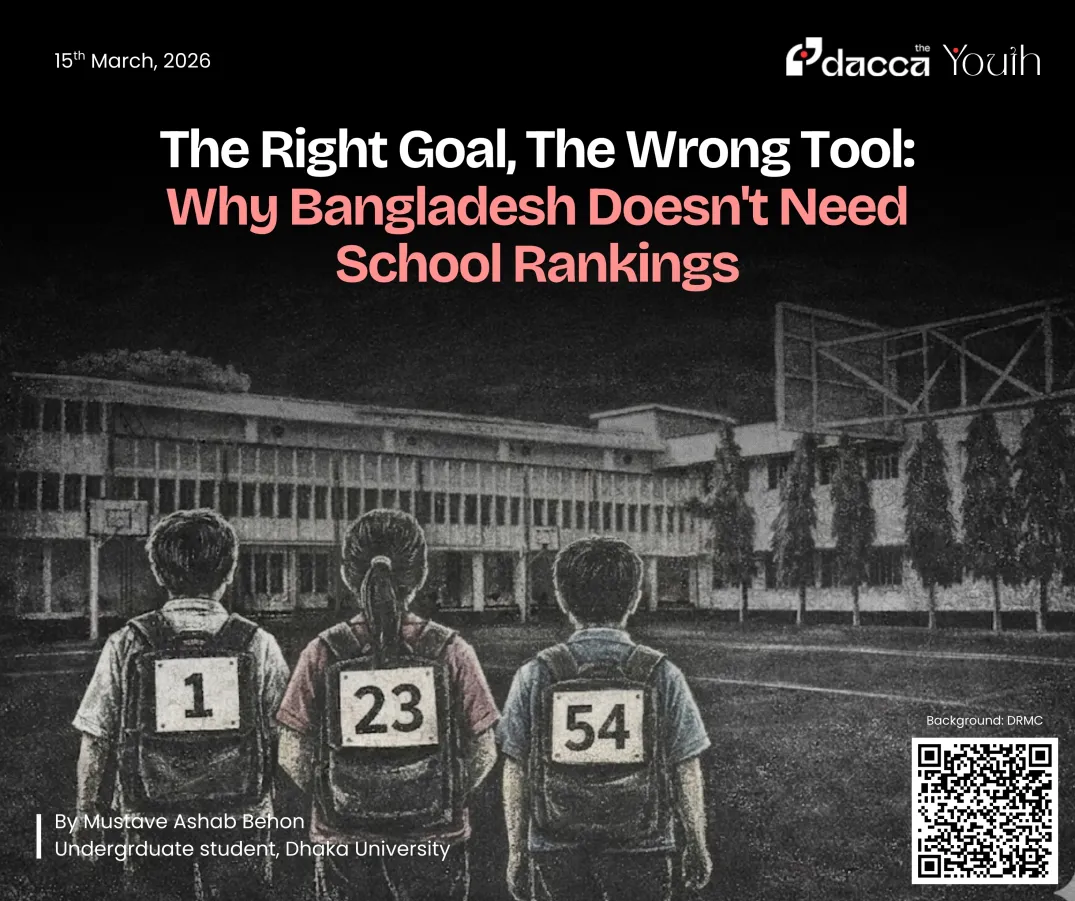
The new government inherited a broken education system — one where getting into a good school depended not on a student's ability, but on a lottery draw introduced during COVID and never removed. That lottery is now being scrapped, and the government deserves credit for it. But alongside that reform comes another new policy: a ranking system for schools and colleges, announced by the Education Minister earlier this month. While the intention is to raise standards and increase competition, this policy will cause more harm than good and will give institutions more room to systematically pressure students.
First of all, rankings will provide the government an opportunity to identify gaps across institutions and help allocate necessary funds and resources to the right places. But ranking is not necessarily the only way to achieve that, and we will come to that later.
There are many negative aspects of a ranking system. To begin with, it will empower the private tuition industry. Government officials have stated many times that they want to permanently stop private coaching, but introducing a result-based ranking system will only strengthen it, let alone slow it down. The Education Minister states that the ranking system will be built upon various metrics such as educational environment, administrative system, and results. Bangladeshi schools already have a tendency to pressure students into private tuitions. While government schools often do not hold classes regularly — with teachers focusing more on private tuition than school classes — private schools take it even further, ensuring that every student joins private tuitions. I was a student of Milestone College, where the school authority pressured us in various ways to join after-school private tuitions held by their own teachers on campus, with the school authority receiving commissions per student from those tutors. An official ranking system based on results will give these schools even more justification to push students into after-school coaching. While the government claims to be against the coaching industry, their own policies will end up benefiting their claimed enemies.
Secondly, society already has a tendency to judge students by the school they attend, and students themselves carry strong institutional pride. The regular clashes between students of schools like Dhaka College, City College, and Ideal College Dhanmondi demonstrate just how far this pride can go. An official ranking system will formally justify society's habit of judging students by their school's name and place additional pressure on students outside top-ranked schools. We already see university students constantly arguing over whose institution ranked higher. Introducing rankings at the school level will subject students to public humiliation from an even earlier age.
Thirdly, many schools already have a culture of forming illegal connections with exam centres to support their students during exams and manipulate results. This trend will intensify once a result-based ranking system is introduced. While government officials claim they will prevent such practices, we have been hearing these claims for years without meaningful action, so this remains an open question.
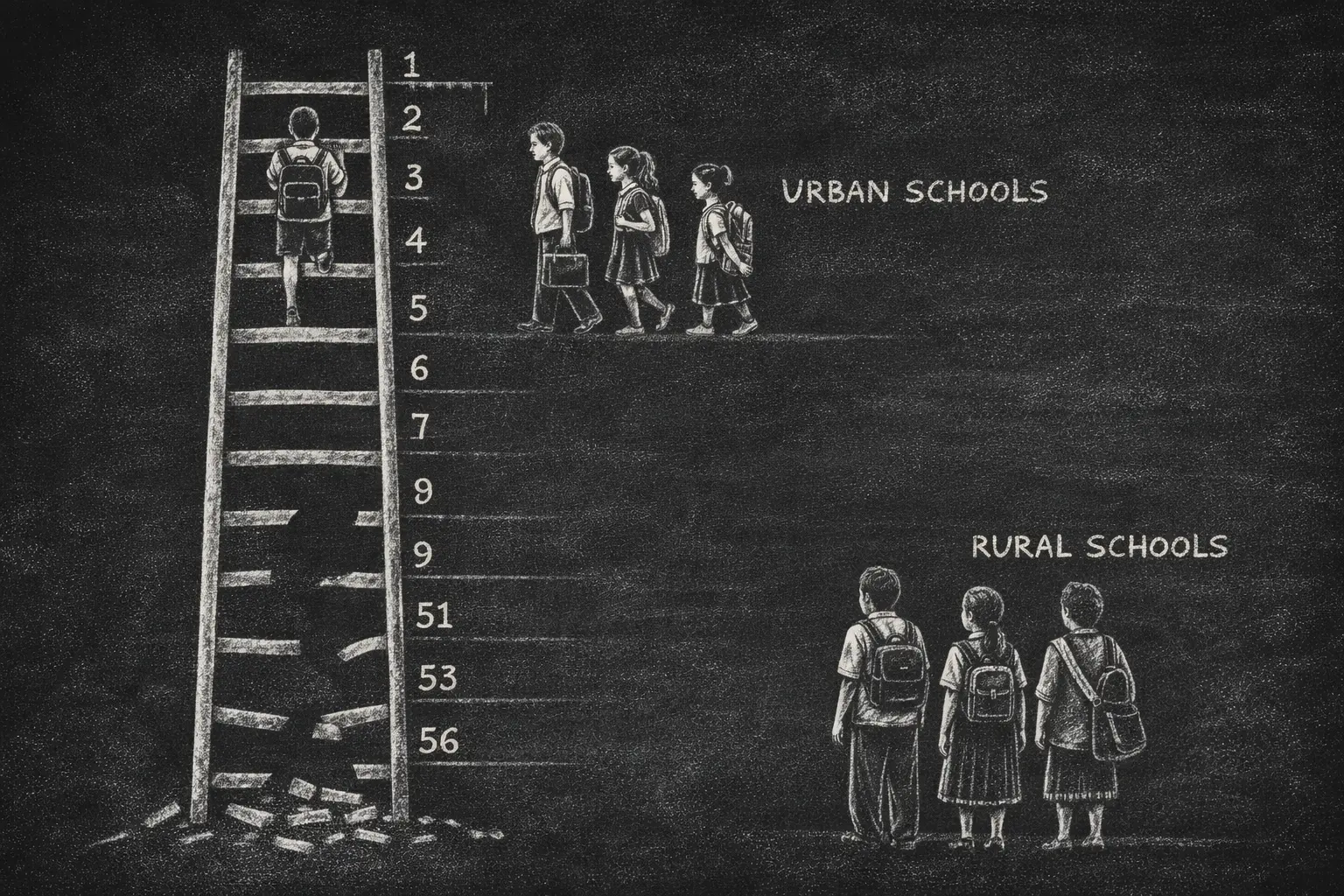
Additionally, the ranking system is fundamentally unsuitable for rural Bangladesh. School rankings reflect the poverty of the community a school serves far more than the quality of teaching inside it. A rural school in Rajshahi serving children of subsistence farmers will inevitably rank below an urban school in Dhaka serving children of professionals — not because the rural teacher is less committed, but because poverty drags outcomes down in ways no classroom can fully overcome. Rankings do not measure what a school is doing. They measure what poverty looks like. In countries that have tried this, lower-ranked schools entered a downward spiral as the published number eroded community confidence. But those communities at least had alternative schools to move toward. Bangladesh's rural families do not. When a village family sees their only accessible school near the bottom of a national table, they receive nothing but a government-stamped confirmation that the education available to their children is inferior. In a country where rural parents already quietly doubt whether local schooling leads anywhere meaningful, giving that doubt an official ranking number does not pressure schools to improve. It gives communities permission to stop believing in them altogether.
The government's goal — understanding which schools are struggling and directing resources accordingly — is a worthy one. But a public ranking list is not the only way to achieve it, nor is it the right way in the Bangladeshi context. The Education Ministry already has the Directorate of Inspection and Audit. Strengthening its reach and regularity across all schools would allow the government to identify funding gaps and address corruption without publishing a league table. Alternatively, the government could introduce an internal school reporting system similar to India's UDISE+, collecting detailed institutional data used purely for resource allocation — never made public. The goal is sound. The tool is wrong. I urge the government to pursue the same outcome through a mechanism that builds schools up rather than one that ranks them down.