

In what many are calling a politically charged power grab, the Bangladesh Cricket Board (BCB) has been thrust into its most turbulent chapter yet. The government’s abrupt dissolution of the elected BCB board and the appointment of a new ad‑hoc committee led by former star batter Tamim Iqbal have ignited firestorms across cricket and political circles alike.
The move has triggered sharp backlash from the ousted leadership, vociferous fan reactions, and allegations of nepotism, political interference, and questionable motives ,leaving many to wonder whether the future of Bangladesh cricket faces more drama off the field than on it.
A New Leader Takes the Chair
In a dramatic shake up announced on April 7, 2026, the National Sports Council (NSC) suddenly dissolved the Aminul Islam Bulbul led BCB board and appointed Tamim Iqbal as president of an 11‑member ad‑hoc committee. This interim panel is expected to steer cricket administration for roughly three months, with a mandate to organise fresh elections.
At just 37, Tamim becomes the youngest chief in BCB history. As per ‘Times of India’, the government backed its decision by citing findings from a five‑member investigation committee that uncovered widespread irregularities and procedural weaknesses in the October 2025 BCB elections. The NSC claims that these flaws undermined the credibility of the previous board and necessitated radical intervention. Though The Dacca did not manage to get its hands to any kind of this report for now.
Aminul Bulbul: ‘Illegal’ and ‘Unconstitutional’
However, the ousted president Bulbul has refused to recognise his removal, blasting the takeover as a “constitutional coup,” “illegal” and lacking legal basis. He insists that the election was fair and transparent, and that he remains the “sole legitimate president” until a court rules otherwise.
Bulbul has even urged the International Cricket Council (ICC) to intervene, suggesting that the government’s actions amount to political interference in cricket governance, a charge that could have serious international ramifications if upheld.
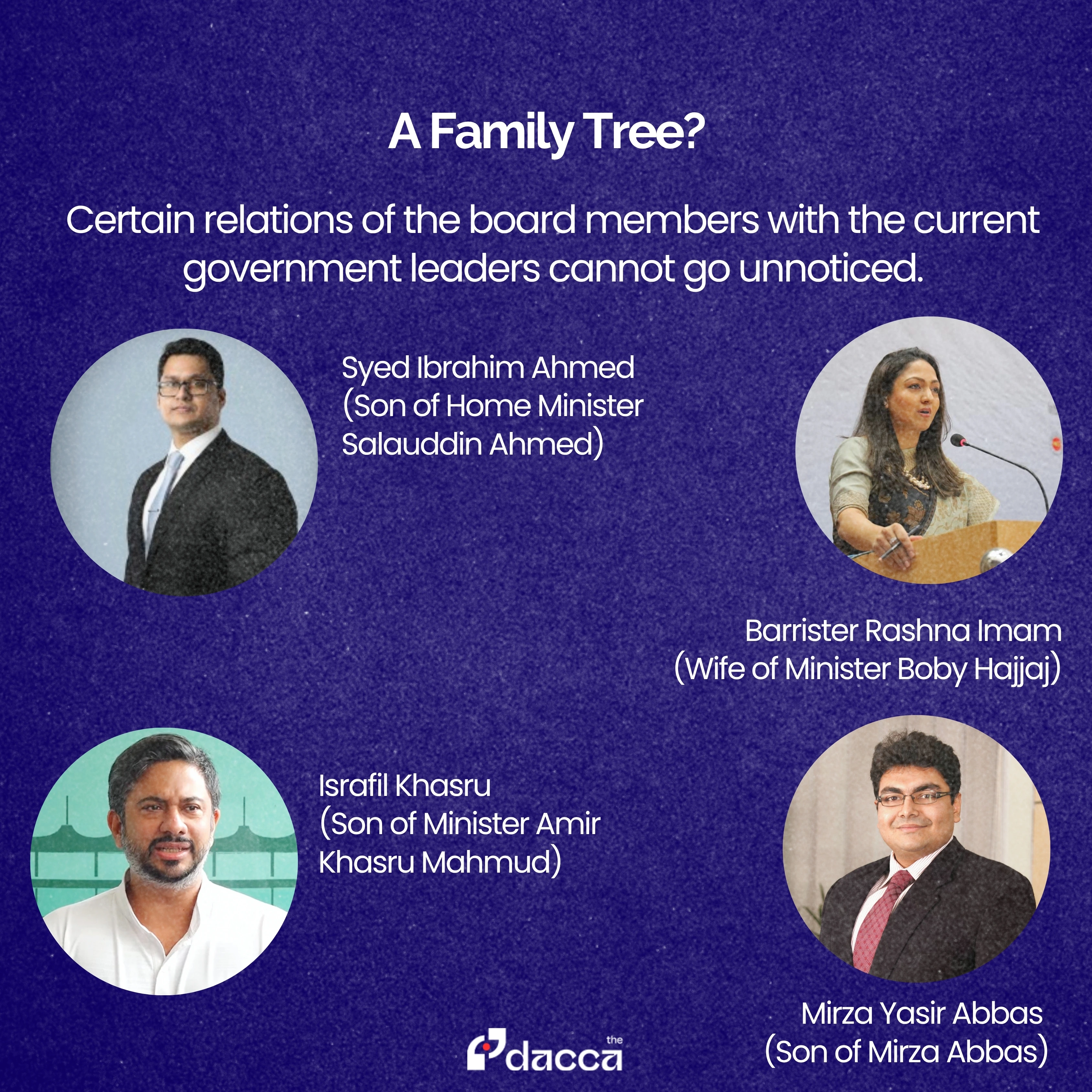
A Family Tree?
Critics have been quick to highlight the composition of the new committee, questioning whether it represents a fresh start or simply an extension of political patronage networks. Several members have familial and social ties to current government leaders, a fact that has done little to quell suspicions of backdoor influence:
⋅ Syed Ibrahim Ahmed -- son of Home minister and BNP leader Salauddin Ahmed
⋅ Barrister Rashna Imam -- wife of state minister and a member of BNP Boby Hajjaj
⋅ Israfil Khasru -- son of BNP leader and of finance and planning minister Amir Khasru Mahmud
⋅ Mirza Yasir Abbas -- son of BNP leader and Advisor to Prime Minister Tarek Rahman, Mirza Abbas
These connections circulating widely on social media and cricket forums have intensified accusations that the BCB’s leadership shuffle is less about improving cricket governance and more about consolidating political clout. Detractors have openly mocked the committee as a “BNP cricket board in disguise,” and questioned whether merit or connections drove these appointments a charge amplified by online critics pointing to ties with major political actors.
Bulbul vs Tamim: A Bitter Standoff
The fallout between Bulbul and Tamim has become one of the most explosive subplots in recent Bangladesh cricket politics. Bulbul’s refusal to step back parallels the public disputes between them before the latest upheaval, where Tamim openly criticised the previous board and called for investigations into election conduct.
Supporters of Tamim argue that the previous board’s decision making including Bangladesh’s controversial absence from the ICC T20 World Cup 2026 over safety disputes damaged both the sport’s global standing and the board’s unity.
Yet sceptics question whether Tamim’s involvement is rooted in public interest or political ambition. Online commentary ranges from claims of “nepo‑baby leadership” to warnings that this could send Bangladesh cricket “back 15 years.”
Public Reaction Has Been Explosive
Public discourse on the new committee has been equally fractious. On one side are fans who argue that the committee lacks deep cricket administration experience, suggesting that the decisions are driven by politics rather than passion for the sport. Critics have likened the board to “politics over progress” and questioned why seasoned administrators were overlooked.
A significant section of supporters lament that the previous board despite its flaws made some efforts to decentralise cricket development beyond Dhaka, a strategic priority long neglected by past administrations. Many see the interim committee as a step backwards, especially given its truncated mandate and internal controversies.
Online forums and social channels have turned into battlegrounds, with some branding the government’s move a “coup”, and others calling for the ICC to suspend Bangladesh cricket if political interference is confirmed.
What Happens Next?
With the ICC already informed of the situation by the NSC, all eyes are now on how the international body will respond. A failure by the ICC to endorse the provisional committee could lead to sanctions or diplomatic pressure, a scenario that would deepen the crisis.
For now, Bangladesh cricket finds itself at a crossroads ripped between governance scrutiny, political subtexts, and the ambitious hopes of reformers. Only time will tell whether this controversial reconfiguration ushers in genuine improvement or merely swaps one set of powerful figures for another.