

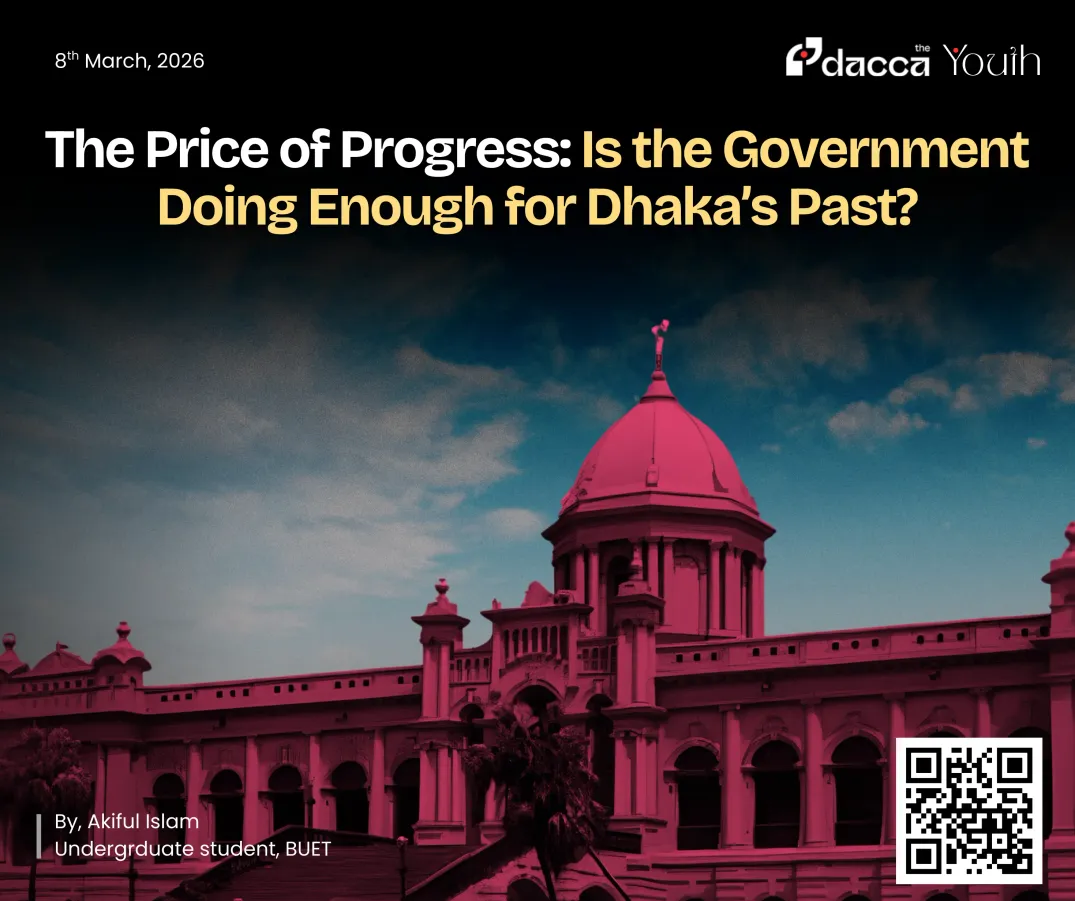
“Dacca is merely the wreck of its ancient grandeur. Its splendid palaces are in ruins, and overgrown with weeds and the most luxuriant vegetation; and the river, which formerly washed the walls of the city, has now retreated.”
-Bishop Reginald Heber (1824)
When Reginald Heber sailed into Dhaka two centuries ago, he encountered a city in a state of romantic decay. Fast forward to 2026: the ‘weeds’ have evolved into a tangle of overhead electric wires. The ‘luxuriant’ vegetation has been replaced by a ruthless concrete jungle, and the Buriganga River — once the lifeline of the subcontinent’s premier riverfront city, has turned pitch black. The cost of an ever-expanding, unplanned skyline is that the 400-year-old heritage at its feet is being squeezed into oblivion.
On paper, the government appears as a vigilant guardian. The Department of Archaeology Bangladesh and RAJUK (the capital’s development authority) maintain a list of protected antiquities. However, a significant gap exists between official designation and actual protection. While the Department of Archaeology maintains a modest list of roughly 35–40 sites within the Dhaka district, the Urban Study Group, a leading advocacy body, has submitted a list of more than 2,200 sites for protection [1].
Without meaningful government intervention, many of these sites face constant encroachment and demolition by private groups, according to critics. For example, 33 Mughal and colonial sites were reportedly plundered within just a four-month period in 2014 [2].
Even sites under official protection fare little better. Just before Eid-ul-Azha last year, part of the iconic Shankhanidhi House on Tipu Sultan Road collapsed. Its distinctive jhul baranda was destroyed, reportedly due to the illegal construction of a bathroom [1]. Outside a handful of well-known landmarks such as Ahsan Manzil and Lalbagh Fort, most of Old Dhaka’s heritage awaits a similar fate. RAJUK’s original 2009 list identified 93 heritage buildings in the capital, but revisions later reduced the number to around 74, with several historic structures removed from protection altogether, and many damaged despite being on the list [4].
Scholars have identified institutional fragmentation as a key bureaucratic factor behind the deterioration of heritage sites in Dhaka. Responsibility of historic sites is divided amongst different government institutions with overlapping jurisdictions. While the Department of Archaeology oversees the designation of protected antiquities, urban development permissions fall largely under RAJUK, and building enforcement is handled by the city corporations. Coordination between these institutions is weak, resulting in regular alterations and encroachment before any intervention can take place[5].
The Antiquities Act 1968 (later amended by the Antiquities (Amendment) Act 1976) is the principal legislation driving the protection of heritage sites in Dhaka. Under this law, the state can declare a structure an “antiquity” if it possesses historical, archaeological, or artistic value [3]. However, the law can only protect individual monuments, while the value of most urban heritage sites depends on the collective urban fabric rather than the brick-and-mortar structure itself. For instance, the historic neighborhood of Shankhari Bazaar derives its significance not from a single building but from its continuous row of narrow multi-story houses, projecting balconies, temples, and specialized craft shops that together form a distinctive streetscape dating back several centuries. Protecting one structure within such an environment does little to preserve the historical character of the neighborhood if surrounding buildings are altered or demolished. This systemic loss of historic characters of different neighborhoods then go on to create the ground for encroachment of remaining structures.
Furthermore, the Antiquities act operates largely separate from urban planning regulations administered by RAJUK and Dhaka South City Corporation. Primarily archaeological in orientation, it is not designed to regulate dense urban centers like Old Dhaka, where redevelopment pressure is high and lucrative.
The government also provides virtually no incentives for private owners to preserve historic structures. Under current regulations, owners of listed buildings are prohibited from modifying their properties but receive no meaningful subsidies, tax relief, or technical assistance to restore them using traditional materials such as lime-surki mortar. Coupled with rising real-estate demand, this lack of incentives has contributed to the demolition of important historic buildings, including structures such as Jahaj Bari [5].
Finally, population growth and unplanned urbanization have created situations in which older structures are often perceived as inadequate for contemporary needs. The demolition of the 400-year-old Hinga Bibi Mosque to construct a multi-storey mosque complex illustrates this dynamic [6].
Historian Muntassir Mamoon states, “It is not only mosques, old structures of all kinds are being systematically destroyed. This is happening due to the indifference and ignorance of the relevant ministries, the conspiracies of encroachers, and the collusion of politicians. If the current situation continues, within the next few decades there will be no historic architectural heritage left in Dhaka.”
Nearly two centuries after Reginald Heber described ‘Dacca’ as a wreck of its former grandeur, the historic city is still under threat. Today, the forces at work are not only slow decay but rapid urban growth, fragmented governance, and laws that cannot fully protect living heritage. As redevelopment continues in the dense neighborhoods of Old Dhaka, the loss of individual buildings increasingly leads to the disappearance of whole historic areas. Without better coordination between heritage protection and city planning, much of Dhaka’s architectural past may soon survive only in old photographs and written accounts, just as Heber once saw the ruins along the Buriganga River.
References
[1] “Preserve Old Dhaka's historic structures,” The Daily Star. [Online]. Available: https://www.thedailystar.net/news/bangladesh/news/preserve-old-dhakas-historic-structures-3919601 (accessed Mar. 6, 2026).
[2] “Historical buildings plundered,” The Daily Star. [Online]. Available: Historical buildings plundered | The Daily Star (accessed Mar. 6, 2026).
[3] The Antiquities Act, 1968, Bangladesh. [Online]. Available: The Antiquities Act, 1968 (accessed Mar. 6, 2026).
[4] “List of Heritage Sites of Dhaka,” Wikipedia, Wikimedia Foundation. Available: https://en.wikipedia.org/wiki/List_of_Heritage_Sites_of_Dhaka. (accessed: Mar. 6, 2026).
[5] M. A. Rahman and M. S. Islam, “Policy Concerns in Heritage Conservation in Dhaka City,” British Journal of Business Design & Education, 2021, pp. 5. Available: http://www.bjbde.org/wp-content/uploads/2021/02/1002008.pdf (accessed: Mar. 6, 2026).
[5] “From Bara Katra to Jahaj Bari: Laws fail to protect Dhaka's vanishing heritage,” The Business Standard. [Online]. Available: From Bara Katra to Jahaj Bari: Laws fail to protect Dhaka’s vanishing heritage | The Business Standard (accessed Mar. 6, 2026).
[6] মোগল স্থাপত্যে হাতুড়ির ঘা, প্রথম আলো. [Online]. Available: মোগল স্থাপত্যে হাতুড়ির ঘা | প্রথম আলো (accessed Mar. 6, 2026).