


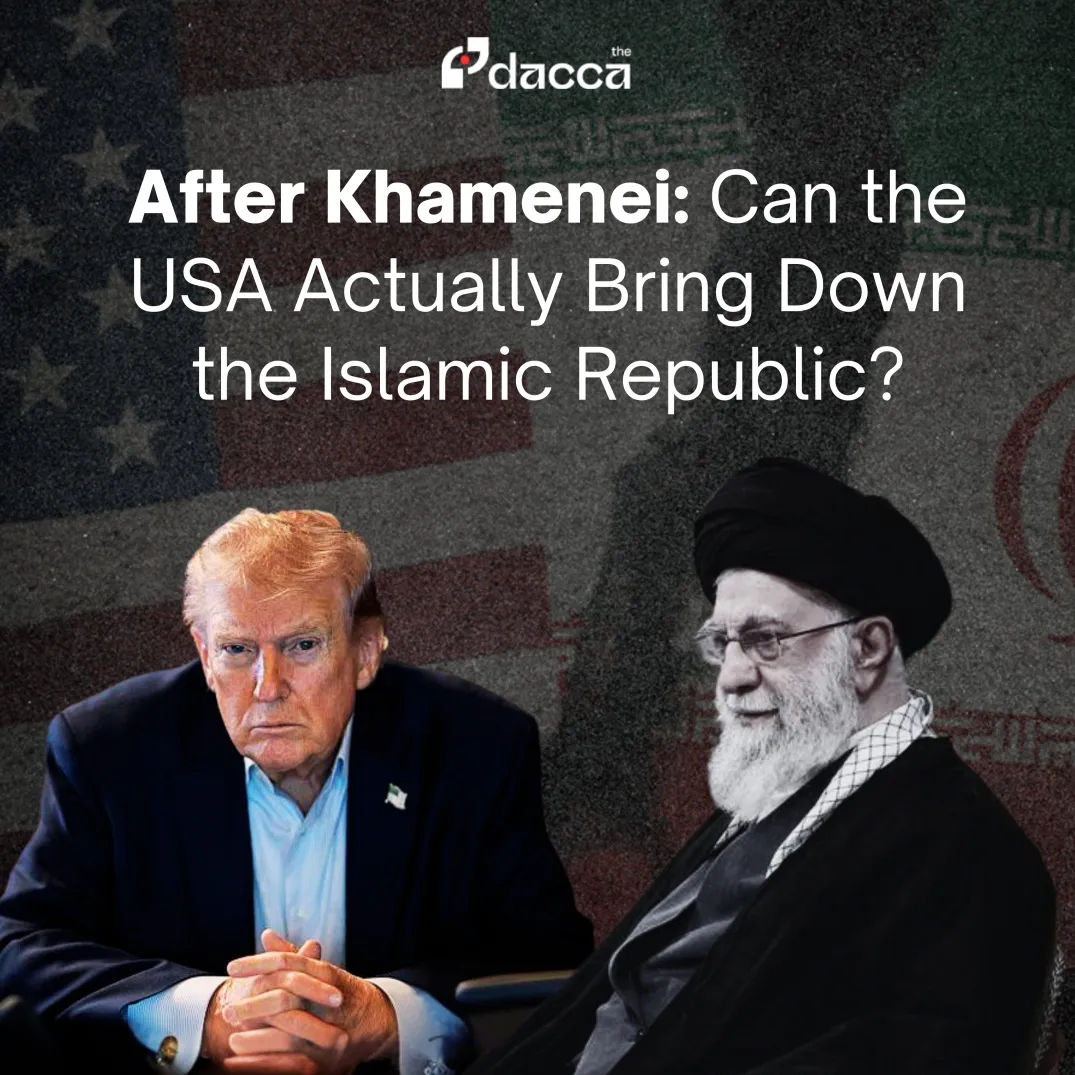
On February 28th, 2026, Ayatollah Ali Khamenei, the man who held the position of Iran's Supreme Leader for 36 years, was killed in a U.S.-Israel joint strike. While Washington and Tel Aviv frame it as a victory, the real question emerges: can the USA actually overthrow the Iranian regime despite this?
To understand this situation, understanding Velayat-e Faqih, the government system of Iran, is a must. At its core, the system distributes power across several institutional layers. The Supreme Leader sits at the top, holding absolute authority over the military, the Judiciary, and key advisory bodies — but he does not rule alone. A President is elected by popular vote, while an 88-member Assembly of Experts, also elected by the people, holds the rare power to appoint or even dismiss the Supreme Leader. A 12-member Guardian Council — half appointed by the Supreme Leader, half by the Judiciary — controls who can stand in elections and can veto parliamentary legislation. An Expediency Council advises the Supreme Leader and mediates disputes between the Guardian Council and parliament. According to a CNN report, the current Assembly of Experts, elected in 2024, consists entirely of adherents of Ayatollah Ali Khamenei.
When a Supreme Leader dies, an Interim Leadership Council forms, consisting of the President, the Judicial Chief, and one member from the Guardian Council. This Interim Leadership Council runs the country until the Assembly of Experts appoints a new Supreme Leader.
Velayat-e Faqih is a system where the Supreme Leader is the head of the country but power is distributed amongst many institutional sub-groups. The system was created after the Islamic Revolution specifically to prevent any single man from becoming the sole power source of the country. That is why the death of the Supreme Leader does not destabilize the Iranian government — it is a deeply institutional system, not a one-person government. As Sasan Karimi, former deputy of Iran's Vice President on Strategic Affairs, explained in Al Jazeera, Iran's constitution is well-prepared for this type of situation and is designed to keep the country running through any power vacuum.
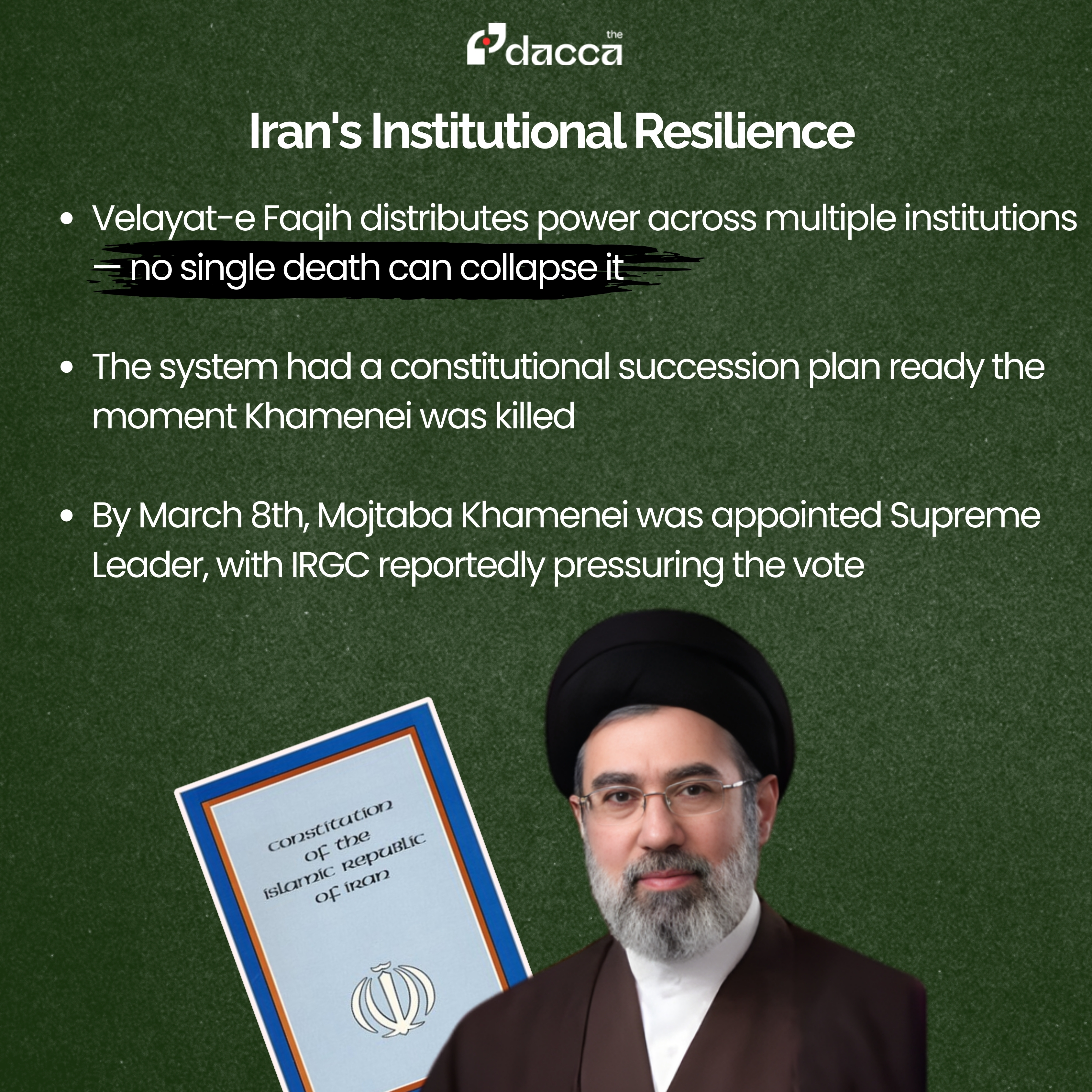
As the system survives this power vacuum institutionally, it brings us to the question of whether Trump's assumption of regime collapse through internal uprising can actually happen. Maha Yahya, the Director of the Malcolm H. Kerr Carnegie Middle East Center, explained in her Al Jazeera interview that internal uprising is very unlikely because there is no credible opposition party in Iran. The system ensures that all election candidates and every government official holds the same ideology. Israeli diplomat Alon Pinkas also confirmed in a separate interview that overthrowing the regime would require a bottom-up enterprise from within Iranian society.
On March 8th, 2026, the Assembly of Experts officially appointed Mojtaba Khamenei, son of the late Supreme Leader Ali Khamenei, as Iran's new Supreme Leader — ending the institutional uncertainty but opening new questions about the war's trajectory. Mojtaba has always maintained a low public profile, never participating in public votes nor holding any official government position. It is widely speculated that the IRGC pressured the Assembly into this appointment, given Mojtaba's past connections with the Corps and his involvement in the Iran-Iraq war. Al Jazeera marks his appointment as a signal of hardliners gaining power at the top, closing further possibilities of any meaningful negotiations.
Additionally, Iran's Foreign Minister Abbas Araghchi confirmed that the Islamic Revolutionary Guard Corps has activated their mosaic warfare strategy, signaling their determination to continue the war even if all of their head commanders are killed. Mosaic warfare divides Iran into 31 independent groups, each with an equal amount of armed force. The IRGC commanders of each group can operate independently without any central command, making their attacks more unpredictable — at times even central commanders remain unaware of ongoing operations. This is a significant development, as it ensures Iran can continue to fight without a central commander, making regime change through military victory considerably more difficult than before.
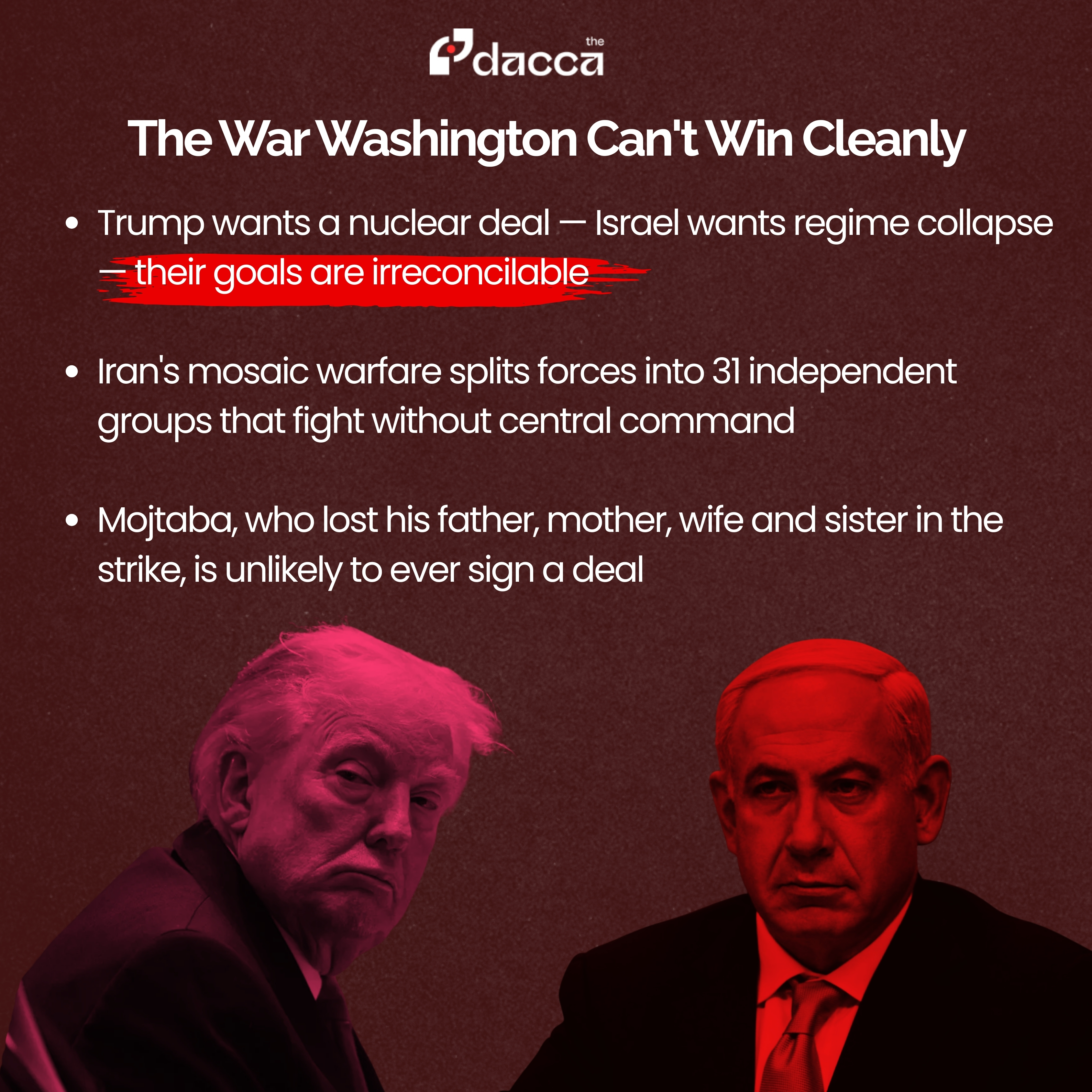
There is also a distinct divergence between the USA and Israel's objectives. Israeli diplomat Alon Pinkas, in his Al Jazeera interview, explained that Trump may seek an early exit from the conflict, aiming to declare victory and impose a new nuclear deal on Iran — what he terms "regime surrender." This aligns with Trump's longstanding desire for a better deal than Obama's. For Netanyahu, however, anything less than the fall of the Islamic regime is not a victory. Trump's stated intention to play a role in selecting Iran's next leader, and his explicit labeling of Mojtaba as "unacceptable," further indicates that Washington is pursuing a deal rather than regime change. The Economist's defence editor Shashank Joshi suggested a similar reading of Trump's approach, though he noted it is unlikely the current Iranian leadership would agree to such terms. And with Mojtaba Khamenei now confirmed as Supreme Leader — a man who lost his father, mother, wife, and sister in the U.S.-Israel strike — the prospect of Tehran signing any nuclear deal seems more remote than ever.
Two further possibilities remain on the table. The first is the USA providing arms to Iran's internal ethnic opposition groups, which could initially make the regime more vulnerable. According to CNN, the CIA had been preparing Kurdish groups in the region for months to participate in armed conflict with Iran. But there is a critical twist. On March 7, Trump reversed course and said he has told Kurdish forces not to enter the Iran war, stating: "We don't want to make the war any more complex than it already is. I have ruled that out, I don't want the Kurds going in." The second is the USA putting boots on the ground and engaging in a direct land war inside Iran. Former U.S. diplomat Christopher Hill, in his recent Al Jazeera interview, called this extremely unlikely. However, Ali Larijani, secretary of Iran’s Supreme National Security Council, warned that Iranian forces are “waiting” for a potential US ground invasion and threatened to kill and capture thousands of US troops.
Another unresolved question is how long Gulf countries will maintain their loyalty to the United States. Around 20,000 U.S. citizens have already left the Middle East — the State Department reports thousands departed unassisted, while the U.S. government scrambles to organize charter flights for the rest. Meanwhile, Gulf states continue to absorb regular Iranian attacks, with civilian death tolls rising by the day. The attacks have also begun targeting critical infrastructure: Israel attacked Iran's water desalination plants — facilities without which no Gulf country can sustain its population — and Iran has responded in kind, hitting Bahrain's desalination plant as well as its only oil refinery, striking at the twin lifelines of one of America's closest Gulf allies.
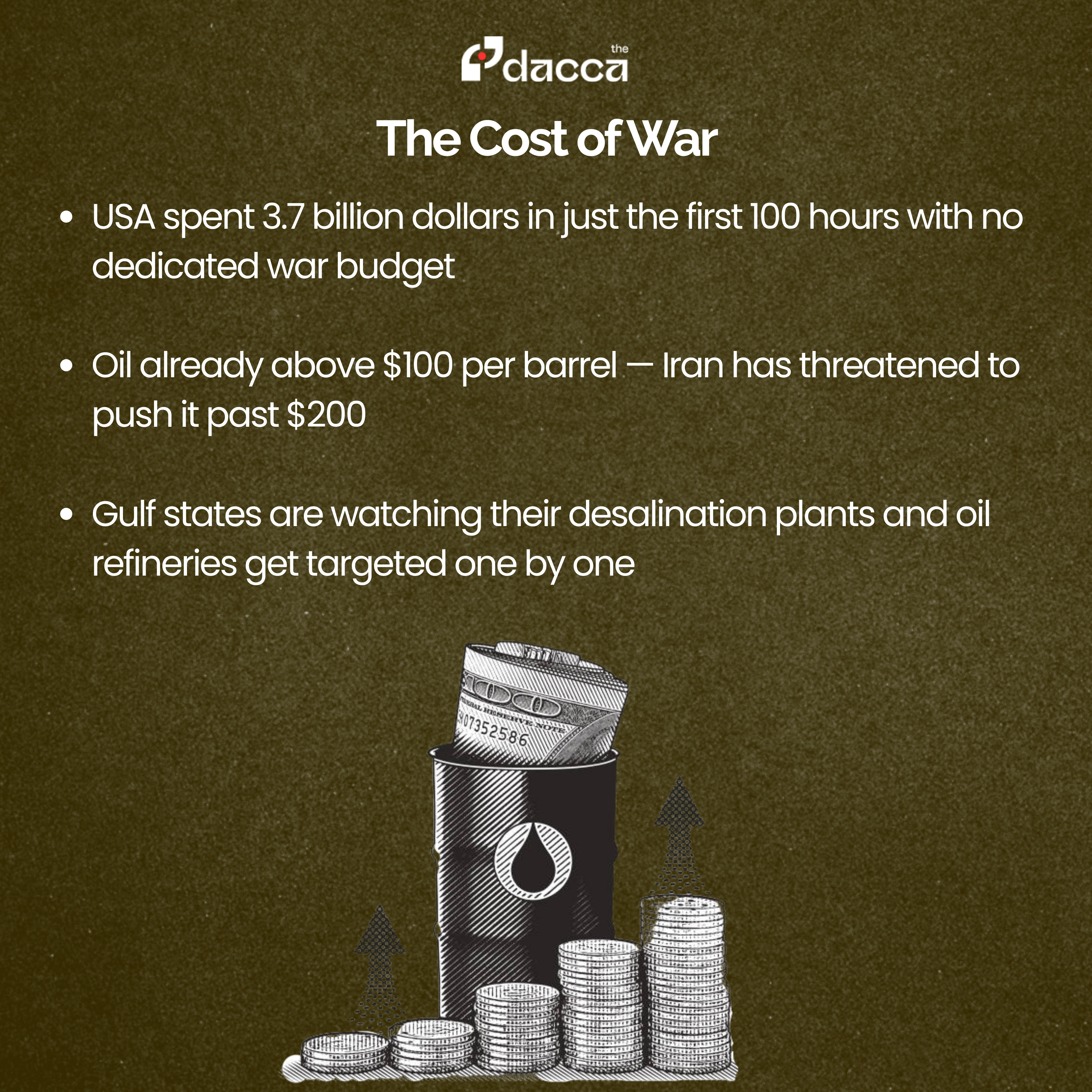
The financial picture on the American side is equally concerning. The Washington based Center for Strategic and International Studies estimates that the United States spent 3.7 billion dollars in just the first 100 hours of the conflict. The CSIS further warns that the U.S. will soon face a budget shortfall, as the FY26 budget contains no separate allocation for this war — meaning the Trump administration may need to request emergency funds through the FY27 reconciliation bill, or ask Congress to redirect portions of the DOD's existing 150 billion dollar reconciliation package to cover the costs. Adding further pressure to this financial strain, oil prices have already exceeded 100 dollars per barrel, and Iran has threatened to push them above 200 — a move that would strain both the American economy and the Gulf states that depend on stable energy markets. Whether the Trump administration can manage these costs internally, or whether Gulf states — themselves under fire, watching their infrastructure crumble and their citizens die — will step in to bankroll a war whose outcome remains uncertain, is a question that has no answer yet.
In the end, Khamenei is dead — but Velayat-e Faqih, and the IRGC that runs entirely on it, are not. The divergence between the USA's goal of regime surrender for a nuclear deal and Israel's goal of complete regime overthrow remains an unresolved conflict of interest. The gap between killing a leader and dismantling a system is not a small one — and as of now, it remains a question without an answer.